

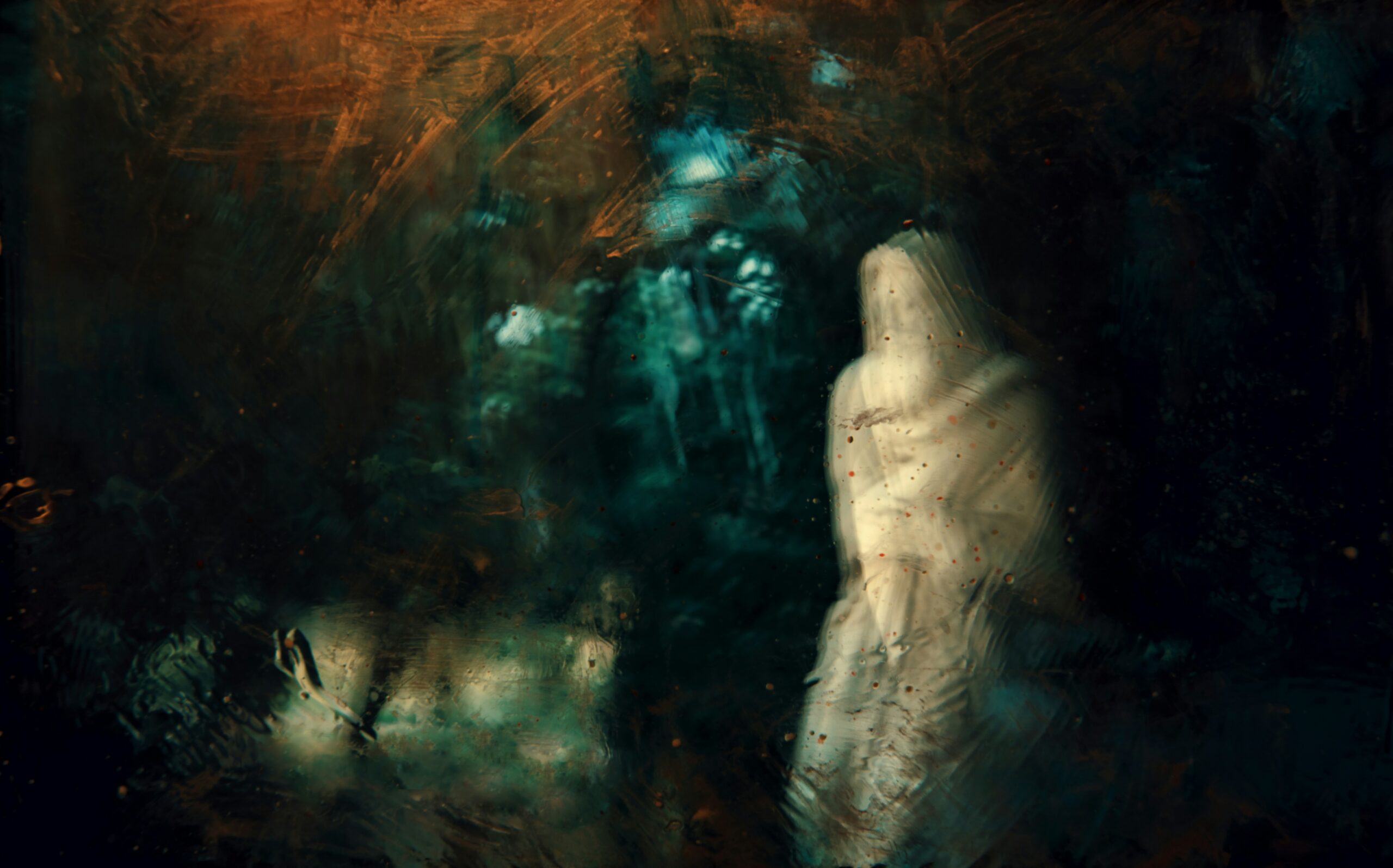


“Me, The Other, and My Mother” is a tender and introspective piece that blends lyrical prose with deep reflections on memory and identity. It follows a middle-aged school principal who, on the eve of turning fifty, receives a mysterious nocturnal visit from his long-departed mother. What unfolds is a quiet, emotionally charged encounter in which the boundaries between life and death blur, revealing old wounds, unspoken tenderness, and the enduring weight of longing. Through Sakin’s subtle fusion of realism and soft magical elements, the story captures the emotional landscape of Sudanese life while exploring universal themes of guilt, love, reconciliation, and the persistence of memory.


I am fifty now—the same age my mother was when God took her, thirty years ago to the day. I am not recounting her story to mark a thirtieth anniversary, as people do for the mothers they love—though I loved mine dearly. I speak now because of the pressure and insistence of her pure spirit. I say pressure and insistence advisedly, for although my mother died more than a quarter of a century ago, I have never once felt her dead. She merely took a long, final leave from the countless burdens of the world—especially from me, her only son, companion of her hardship and her joy. With time, even that leave proved brief, for thirty years are truly little in the time of the dead. They say their dying can last forever.
It was only yesterday—after a long day at the basic school where I serve as principal, followed by a shabby evening at the teachers’ club filled with cards and meaningless chatter—that I returned exhausted to the house where I live alone. My eldest daughter married this week and set off with her husband to roam God’s wide earth, just as her two younger sisters had done in the last two years. Even my wife married again more than a decade ago—so they say, to her first love—after divorcing me in the personal status court on the claim that I was useless as a husband and a man, and that she had grown to hate me.
God knows I am no hateful creature; the proof is that my three daughters chose to stay with me, refusing to move with her to their grandfather’s house and then to her new husband’s. Which of us, then, is the detestable one? A question I avoid altogether—she is, after all, the mother of my girls.
Worn out, I crawled to my bed and let myself fall upon its kind, familiar coverlet. It is the last thing I have that connects me to a mother, a wife, and daughters—the only source that still offers me tenderness as it folds around my thin, ageing body. As usual, I left a faint, stingy light glowing from a Chinese energy-saving bulb. I was about to close my eyes when I heard a chair scrape across the tiles. In that pallid neon glow, I saw a young woman dragging the chair toward me and sitting down at my bedside. She looked at me with unmistakable tenderness. A man alone like me should have been terrified—mad with fear even—but instead I cried out in bewildered welcome:
“God! Mother Amna!”
The young, beautiful, gentle woman smiled and began to speak softly. She told the story of my life from the very minute of my birth—event by event. I listened in silence and amazement, as if the teller and the told were two lost twins of mine. Gradually, I discovered that my life had been full of sin, that I had chased after the world’s pleasures and slips; though some incidents suggested I possessed nobility and a clean heart, the final tally, as she put it, stood thus. I do not know how long she sat there recounting, only that it was long; nor how many tales she told, only that there were many; nor when I fell asleep, only that I slept extremely late, for I did not wake—like school principals do—at four in the morning. The night guard shook me awake, astonished, at the mid-morning break around half past ten. His tangled, stammering speech tried to convey that everyone had missed me.
One sentence of my mother’s kept ringing in my head:
“I’m with you every day, moment by moment.”
I told no one what passed between us—for fear of mockery, or pity, or being accused of madness. I might lose my job if the authorities decided I had lost my mind, and some would welcome that. I have plenty of enemies. I kept it secret. My eldest, Amona—named after my mother—phoned to ask after my health and loneliness, hinting that I ought to marry, even an older woman; in her view I needed companionship. She knew a beautiful divorcée in her forties with two children. I pretended not to catch her meaning, perhaps because I no longer wished to marry. A woman, to me, has become a beautiful creature fit for everything except marriage.
That evening, I was prepared for Mother Amna’s lesson. She appeared in all her youth and loveliness, dressed in clean, bright, colourful wrappers.
“You’re ready early tonight,” she said.
A strange thought struck me, and I acted on it at once—my thoughts go straight to my fingers. I reached to touch the fabric of her wrappers; my palm closed on nothing. Pure air. She vanished. From the far side of the room, her voice—still sweet after all those years under the earth—called out:
“I am image and sound—image and sound only.”
“I fear this is nothing but hallucination,” I replied.
Her answer came in the very voice that walked with me through all my childhood:
“I was always near you.”
My mother and I had been intimate friends. We had lived through years of hardship and years of rare joy. I am her only son, and to this day I do not know of any father I might claim. From the moment my eyes opened, I knew this quick, gentle creature who never rested, scurrying like the earth’s ants in search of a grain of life we might share. She provided everything I demanded, however stubbornly. I remember once begging her for a bicycle like my classmate Abakar Ishaq’s. I remember her shouting, flinging whatever was in her hand at me in a storm of anger, crying:
“Who do you think you are? The son of al-Sadiq al-Mahdi?”
Of course, I did not know who al-Sadiq al-Mahdi was, but her question forced another into my mind: Whose son am I? I did not ask her; the question did not press upon me. I did not know a father’s value or role, and so I did not miss him. None of the men in our quarter did anything my mother could not do. In fact, she did what they could not: she built our house with her own hands; she piled earthen embankments to keep the floods from sweeping away our hut near the seasonal stream. Fathers did none of that. They hired labourers even to make their quilts and mattresses. It astonished me.
My mother worked outside the home as well, selling tea and coffee at the prison gate. Everyone borrowed from her—even the warden. Things were muddled in my young mind. Only now do I learn from her that one of al-Sadiq al-Mahdi’s alleged duties is providing bicycles to his children. But what settled the matter for the last time was that, three months later, Mother Amna bought me a bicycle. Second-hand, not new like Abakar’s—but my friends assured me it was a fine machine, better than his.
She made zalabiya fritters and I sold them at dawn. She worked as a cleaner at the prison after the morning tea, and when she left that job, she turned into a teaseller at the prison gate, turning yesterday’s colleagues into today’s customers. She even rivalled Um Bakhout, once her client, now her competitor. As for me, I was wad Ummu—the mother’s boy—who never left her side. After school I went to her stall, washed the cups, carried distant orders, bought tea and sugar, told her about pupils and teachers. When I grew sleepy, she spread a palm-fibre mat for me behind her stall, and I lay down with my schoolbag for a pillow, my beautiful bicycle at my feet.
I asked her boldly:
“Where are you now? In heaven? In hell? In this world? And where were you all this time?”
She said, “I am here.”
She asked me about everything I had done, just as she used to sit at the foot of the bed, sometimes speaking, sometimes falling silent, yet always answering me with sincerity. This was our daily ritual. But now she wanted to make something clear to me: that what I was doing was neither acceptable nor necessary.
“Am I harming myself?” I asked.
“Am I harming nothing at all?”
Yet I could find no convincing answer to either question.
Then she asked:
“Do you accept your daughter Amona’s suggestion?”
“I don’t think I’m fit to chase women anymore,” I said. “I have grown old; all that is gone from me. I can look after myself—food, drink, cleanliness. The only real woman in my life is you—and that is enough.”
Mother Amna smiled—deeply, sweetly—then slowly dissolved into the room’s air.
Early the next morning Amona called again. She said she would arrange a meeting with the beautiful divorcée, and afterwards I would be free to decide.
She was beautiful indeed, with a smile always on her face. She needed no reason to laugh—she laughed all the time—and could coax even the bleakest soul into answering her smile.
But the strange, astonishing, frightening thing was this:
She wore the very clothes my mother Amna had worn the night before.
The same shoes.
The same voice.
The same way of speaking.
The same face.
The same smile.
I could swear she was the same woman.
Khartoum — 11/6/2008








Comments