

Gabriel García Márquez published this short story in 1962, at the age of 35. He was already a well-known journalist in his native Colombia, having published a few years prior, in serialized form, News of a Shipwreck. Later included in The Funerals of Mamá Grande, “One of These Days” is a masterful exploration of political violence, individual and collective, in a small town not unlike the one the author grew up in, Aracataca, in Colombia’s Caribbean coast. The direct antecedent is Hernando Tellez’s story “Espuma y nada más” (1950), where the role of the dentist is played by a barber. García Márquez is clearly the superior writer.
Read in:
English


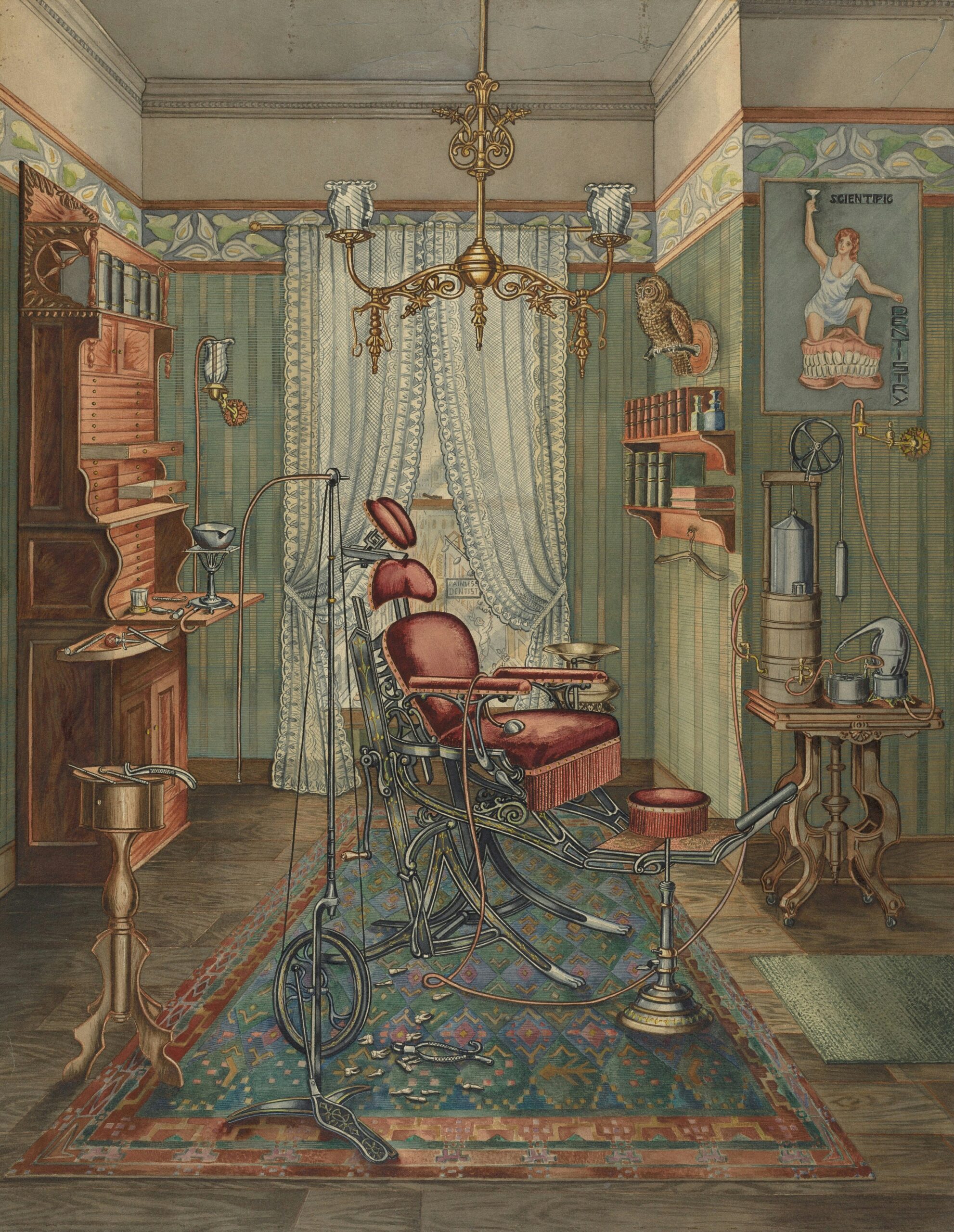
Monday dawned mild and without rain. Don Aurelio Escovar, an unlicensed dentist and an early riser, opened his office at six. He took a set of false teeth, still mounted on its plaster cast, from the display case and placed a handful of instruments on the table, arranging them from largest to smallest, as if for an exhibition. He wore a collarless striped shirt, fastened at the neck with a golden button, and trousers held up by elastic suspenders. He was stiff and gaunt, with a gaze that rarely matched the situation, like the gaze of the deaf.
When he had arranged everything on the table, he rolled the drill over to the spring-mounted chair and sat down to polish the false teeth. He seemed not to be thinking about what he was doing, but worked with stubborn determination, keeping the drill pedal moving even when he had no use for it.
A little after eight, he paused to look at the sky through the window and saw two thoughtful vultures drying themselves in the sun on the ridge of the neighboring house. He went back to work, convinced that it would rain again before lunchtime. The shrill voice of his eleven-year-old son brought him out of his abstraction.
“Papá.”
“Qué.”
“The mayor says, would you pull a tooth for him?”
“Tell him I’m not here.”
He was polishing a gold tooth. He held it out at arm’s length and examined it with half-closed eyes. From the waiting room, his son shouted again.
“He says he knows you’re here because he can hear you.”
The dentist continued examining the tooth. Only when he had placed it on the table, the work finished, did he say:
“Better.”
He started up the drill again. From a small cardboard box where he kept unfinished jobs, he took out a multi-piece bridge and began polishing the gold.
“Papá.”
“Qué.”
His expression had not yet changed.
“He says that if you don’t pull his tooth, he’ll shoot you.”
Without hurrying, and with an extraordinarily calm movement, he stopped pedaling the drill, withdrew it from the chair, and opened the bottom drawer of the table all the way. The revolver was there.
“Bueno,” he said. “Tell him to come and shoot me.”
He turned the chair until he was facing the door, one hand resting on the edge of the drawer. The mayor appeared in the doorway. He had shaved his left cheek, but on the other, swollen and painful, he had a five-day beard. The dentist saw in his weary eyes the traces of many nights of despair. He closed the drawer with his fingertips and said softly:
“Have a seat.”
“Buenos días,” said the mayor.
“Buenos,” said the dentist.
While the instruments boiled, the mayor rested his head against the chair’s headrest and felt better. He breathed in a frigid smell. It was a poor little office: an old wooden chair, the pedal-operated drill, and a glass-fronted cabinet containing ceramic jars. Opposite the chair was a window with a cloth screen reaching halfway up the wall. When he felt the dentist approaching, the mayor braced his heels and opened his mouth.
Don Aurelio Escovar turned his face toward the light. After examining the damaged tooth, he adjusted the mayor’s jaw with a cautious pressure of his fingers.
“It will have to be done without anesthesia,” he said.
“¿Por qué?”
“Because you have an abscess.”
The mayor looked him in the eye.
“Está bien,” he said, and tried to smile. The dentist did not return the smile. He carried the pot of boiled instruments to the worktable and removed them from the water with a pair of cold tongs, still without hurrying. Then he nudged the spittoon with the tip of his shoe and went to wash his hands at the washbasin. He did everything without looking at the mayor. But the mayor never took his eyes off him.
It was a lower molar. The dentist spread his legs and gripped the tooth with the hot forceps. The mayor clutched the arms of the chair, putting all his strength into his feet. He felt an icy emptiness in his kidneys but did not utter a sigh. The dentist merely moved his wrist. Without rancor, with something closer to bitter tenderness, he said:
“Here you are paying us for twenty muertos, Lieutenant.”
The mayor felt the bones in his jaw crackle, and his eyes filled with tears. But he did not sigh until he felt the tooth come out. Then he saw it through his tears. It seemed so strange in relation to his pain that he could no longer understand the torment of the five nights that had preceded it. Bent over the spittoon, sweating and gasping for breath, he unbuttoned his tunic and fumbled for the handkerchief in his trouser pocket. The dentist handed him a clean cloth.
“Wipe your tears,” he said.
The mayor did so. He was trembling. As the dentist washed his hands, he noticed the collapsed ceiling and a dusty cobweb containing spider eggs and dead insects. The dentist returned, drying his hands.
“Lie down,” he said, “and rinse your mouth with salt water.”
The mayor stood up, took his leave with a casual military salute, and headed for the door, stretching his legs, his tunic still unbuttoned.
“Send me the bill,” he said.
“To you or to the municipio?”
The mayor did not look at him. He closed the door and said through the wire screen:
“Es la misma vaina.” It’s all the same damn thing.
“Un día de estos” by Gabriel García Márquez, translated from Spanish by Ilan Stavans. Copyright by Ilan Stavans, 2022.







Comments