



Read in:
English


–Crazy, isn’t it?
–It’s happening in our own lifetime!
–Still can’t believe it.
–Neither can I, not until I’ve seen it with my own eyes.
Autumn 1977. President Sadat’s plane is about to land at Ben-Gurion airport. Our agitation is growing by the minute. No matter what we try to say, “it” takes over: the unprecedented event over there, as much as the sense of unreality washing over us here in Paris.
The live broadcast begins. A Boeing appears on the screen. Nervousness breaks out in giggles and exclamations. A magic carpet would not have thrilled us as much. The doorbell rings. Sitting nearest to the door, I get up.
–Yehuda, check first! Orit, a medical student, warns me.
–Of course! I peep into the spyhole.
It’s Elon. I open up. He is with another young man.
–He’s coming! Orit urges.
We hurry to the TV room. Elon introduces, in English, the newcomer to the dozen Israelis dazed by the small screen.
–This is Fuad… We just met in a bistro. He’s from Cairo.
They throw a quick look at him. The well-mannered murmur a greeting and return to the impending guest in the box.
–Please, sit down! Uri, already a veteran resident in Paris, proposes politely.
Where? There are no seats free. Elon had been quick enough to pinch mine – as quick as he had been to turn up with an Egyptian guest for this historic occasion.
Smiling his way into the middle of the room, Fuad crosses his legs and sits on our burgundy carpet. I do the same. Elon grins.
–Comfortable in my chair, Elon?
–You look like brothers, he says.
Fuad is dark with black curls all right. Yet my complexion is paler, my lips narrower, my nose bonier.
–All dark people look alike, don’t they?
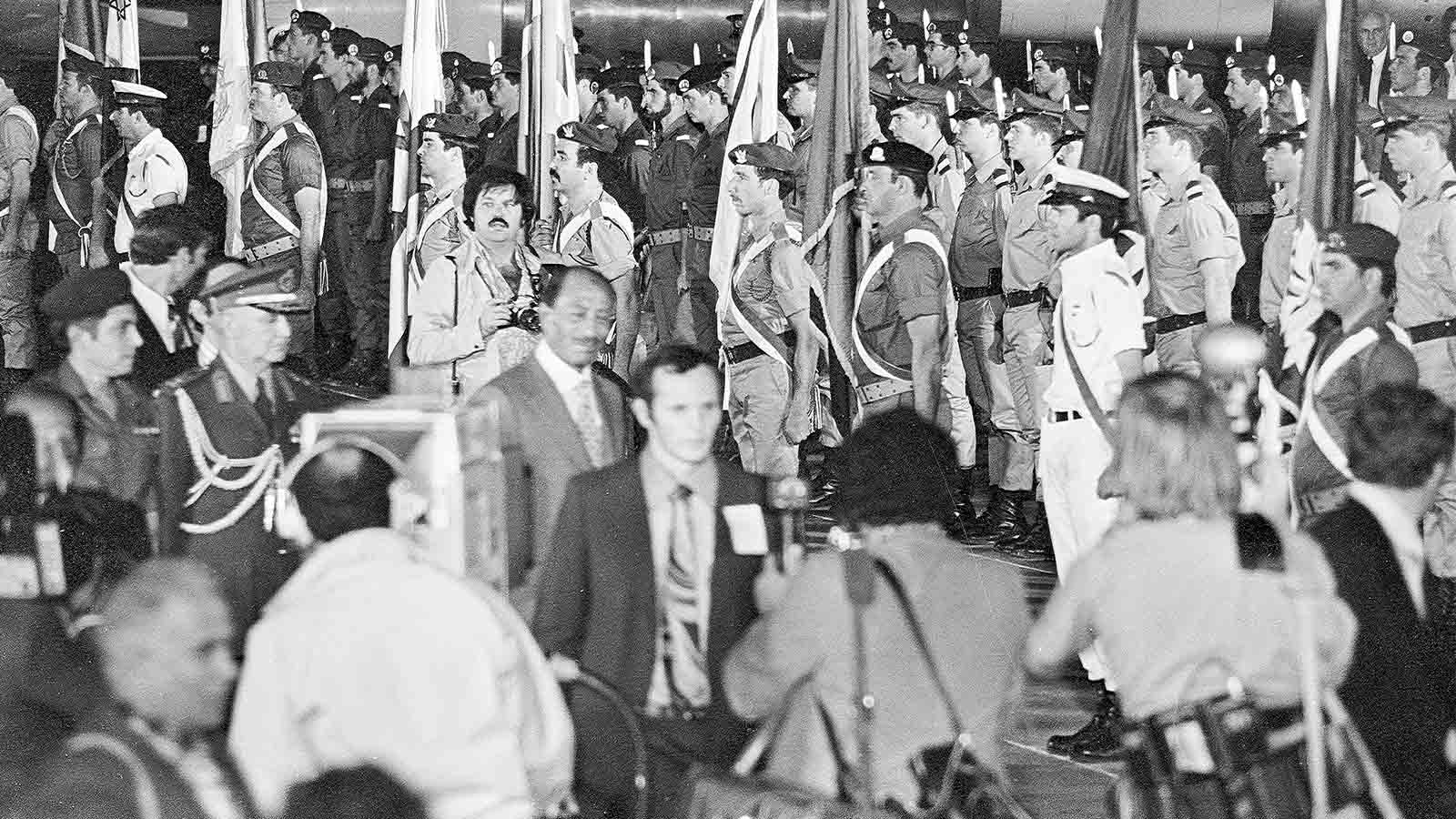
The Egyptian president sticks his head out of the plane and saves Elon the trouble of making a clever retort. Sadat steps down the stairs into the lion’s den, waving his hand, smiling like the hero he has just become. Applause roars from the background, cheers from the back of the room. Sadat and Begin perform the historic handshake they owe to millions of spectators.
Sadat is striding along the red carpet. Face to face with Dayan, he looks delighted, highly amused to meet the famous one-eyed general in the flesh. He moves on, greeting sworn enemies with the familiarity of old school chums, embracing Golda, joking with Sharon – about the last war perhaps?
The picture gets hazy. I wipe my tears. Fuad puts his face in his hands.
–Mush ma’oul, he mutters.
–La’, mush ma’oul, I hear myself answering.
Fuad doesn’t respond. Hasn’t he heard me, or does everything seem plausible tonight? If a Boeing may fly from Cairo to Tel Aviv, if Sadat may embrace Golda, if the Israeli military orchestra plays the Egyptian national anthem, if an Egyptian walks straight into an Israeli club in Paris, why can’t an Israeli Jew start speaking Arabic?
Sadat reviews the guard of honour.
–They’re the most civilized among the Arabs, a voice whispers in Hebrew.
–Their origins are barely Arabian, Uri corrects.
–They’re not our cousins for nothing, adds Elon, without the undertone of irony with which we, the Children of Israel, usually define our relationship to the Children of Ismael.
The event is working its spell upon us all. The Egyptians, who fought four wars against us, have ceased to be our enemy overnight and turned into warm-hearted, good-natured, cultured, humble, and lively peace-makers.
The two leaders disappear into the dark Volvo. Uri switches off the television. Silence falls upon the room. Slowly we stand up and put on our jackets. By unspoken consent we go separate ways, saving political discussions and controversies for some other, more commonplace night.
With a shalom and a grin, Fuad takes off too, as prosaically as he came in. Elon, busy buttoning his overcoat, doesn’t notice his departure. The memory of his visit is already fading. Not only did Sadat’s visit render Fuad’s possible, it also coloured it with misleading shades of normality.
A chilly gust whips my face as I step out. Hands in my pockets, I hum the Egyptian national anthem and conjure up Jerusalem. Hordes of people, young and old, will be out in the streets, carrying children on their shoulders, displaying improvised banners, hailing the Egyptian president, singing Israeli peace songs. What bedlam! And the traffic jams? And the security measures along the King David? I bet the whole nation is too excited to get a wink of sleep tonight.
I reach the heart of le Latin. Paris is celebrating itself on a normal Saturday evening. Cafés and restaurants and cinemas are packed, the streets teeming with young people. I try to spot a familiar face, only to remember that I have nobody to look for. Nor is there any particular place I am heading to, I’m just flânant – as the French say. However, six months of wandering through gardens, palaces, museums, churches, bridges, markets and embankments have left me indifferent and disillusioned, as if embraced by a cool, distant beauty.
I watch a fire eater at St-Germain-des-Près for a while, after which I suddenly feel chilled to the bone. An unusually cold November, so they are saying. I survey the café verandas, uncertain whether to allow myself a hot drink before taking the métro home. Isn’t that Fuad nursing a glass of beer? Before I have made up my mind, he is waving me in. His cheekbones are too broad, he can’t resemble me. Or was Elon only teasing?
I walk inside.
He stands up.
–Ahlan wasahlan bil ach.
He calls me his brother, shakes my hand, points to the chair next to him.
We sit down side by side. I introduce myself.
–Yehuda! Your name’s Yehuda? Fuad asks in English.
I nod.
–But that’s like Yehudi – Jew….!!
I confirm, surprised at the connection which had never occurred to me before.
–I’m only here for a few days, Fuad says. Tomorrow I take the boat-train to London. From there I fly to America.
His brother owns a menswear shop in New York. Fuad will work for him and save for a trip around the world. In exchange, I tell him I am learning French in preparation for the medical faculty in Paris. He whistles.
–Israelis have a good head.
His profile smiles. I stretch out my legs, beginning to feel at ease.
And then he asks,
–You speak Arabic?
So he didn’t miss my remark back at the club.
Did I speak Arabic?
At school, children used to make fun of the way I talked, taunt my language as nonsense. Once the teacher had spoken to my parents – both immigrants from Baghdad – she realised that I had been brought up in a pidgin of Hebrew and Arabic. With her assistance, I learned to distinguish between the two languages, cultivate the one and suppress the other. Although she didn’t explicitly call it the language of the enemy, bad blood was in the air and I knew enough to put Arabic in its entirety out of my mind.
Or so I thought. Until Sadat broke the mould and dug it all up. Terms of endearment. Courtesies. Swear words. Sayings. Random words for food, for feelings. For the weather.
The waiter brings my hot chocolate.
–Shoueye…. a little… min el bet… from home… from television… we have Egyptian films on TV every Friday.
–Ya salam, he chuckles.
Whether it’s my crumbs of Arabic he is impressed with or the Egyptian films broadcast on Israeli television, I can’t tell.
–I’ve an uncle who’s also called Fuad, I add.
I don’t mention that my uncle changed his name to Herzl when he immigrated to Israel.
–Fuad means heart in Arabic, did you know?
–I know now.
The waiter clears our table. On his last night, Fuad wishes to see Montmartre.
I lead the way. We jump over the métro turnstiles, ride the train till Barbes Rochechouart. Climbing the side streets up the hill, the Sacré Coeur gradually comes into view.
Artists are painting under red and green parasols at Place du Tertre. We stroll among the crowd of tourists, soaking up the atmosphere, admiring the art exhibits – mostly romantic cityscapes of the French capital.
Fuad is drawn to the portraitists. It runs in the family, I’m told. On their silver wedding anniversary, his parents had commissioned an artist to paint their picture. On their separate visits to Europe, each of his four siblings returned with their pencilled or charcoaled portraits. All pictures were framed and hung next to one another in the living-room.
–Time to add my face to the collection! He wanders from one artist to the other, haggling over the price.
Only to be puzzled, and terribly disappointed that none is ready to negotiate.
He asks me why I am chuckling.
–Paris is great fun with you, Fuad!
At the fringe of the Place, a young man is cutting silhouettes out of small black squares. Without hesitation Fuad orders two. I protest. The scissors work fast, creating our shadows. Fuad parts with his last ten francs. He hands me my profile, immediately snatches it back and offers his in return. As a souvenir of an exceptional evening, he says and inserts my silhouette between the pages of his passport. I am amused, oddly moved by his gesture, as if I have been admitted to his family album.
I smooth his silhouette into my wallet and consult my watch. It is shortly before midnight. Shivering with cold again, I start longing for the warmth of my room. I ask Fuad where he is staying tonight.
–Gare du Nord. My suitcase’s there.
–But it’s freezing.
He had planned on travelling with the night train. There were no vacancies, he was told in the afternoon. So he bought a day-ticket, paid double the fare, and gave up his room at the hotel.
–Come to me then.
–Kathar cheirak, Bro.
We get off at Pereire and walk through backstreets to my place.
He marvels at the spiral staircase and skips up the first two floors. By the third, he is sweating. By the fourth he is short of breath. By the fifth, he refuses to go on. By the sixth, the light goes out. At the seventh floor, he is staggering.
–Hundred and forty-four steps, every day! He whistles into the helix. No wonder the Israeli army’s so good, they have Yehudi with them!
I used to be a pencil pusher in the army and I’m not terribly proud of it.
–Yehuda! I correct him.
He follows me through the narrow dim corridor, repeating my name in amusement. I don’t reply. Suddenly, he tickles me in the ribs and whispers,
–But we surprised you on Yom Kippur, didn’t we?
Startled, I push his hands away. I am tempted to bark out that his national pride in Egypt’s surprise attack on our Holy Day is distasteful. Or to repeat the vicious jokes we made about them after the Six Day War.
–In what army corps did you serve? I ask instead.
Served? Not him. Baba bought him out, as well as all his brothers.
–What are you so proud of then?
Ma’alesh! He was only joking, he assures me, and pats me on the shoulder.
mo
I unlock the door to my room.
It reeks of fried eggs. I hasten to open the window. Fuad is enthralled by the attic-room. Roofs are flat in Egypt, walls and ceilings meet strictly at right angles, he points out while he runs his fingers along the diagonal walls.
He is scanning every fraction of my eight square metres, as if it were a doll-house. I spread the sleeping-bag between bed and wardrobe. He is studying the family snaps and post-cards pinned up above my pillow. If only he didn’t touch everything he saw.
Without warning, he turns around and takes me in his arms.
–How stupid prejudices are! Wait until my brother hears it. I slept at an Israeli’s, his name was Yehudi and he didn’t stab me in the back!
–Yehuda, not Yehudi!
He doesn’t register my irritation. Just squeezes my shoulders and sniggers. I excuse myself and make off for the toilet in the corridor. How stupid prejudices are – but he keeps calling me Jew! How stupid prejudices are – but isn’t it a wonder that I didn’t stab him in the back? His mention of stabbing troubles me in particular, even if phrased in the negative. I pull the chain.
He takes off his coat, his shoes, his jumper. His shoulder-blades are wide, his muscles well-defined. He slips into the sleeping-bag with the rest of his clothes on. There is hardly any space left to move. It wouldn’t have killed him to spend a night at the station. Why the hell did I invite him over in the first place? – I hardly know the fellow. Because we’ve fallen for Egypt overnight? Because he bears the same name as my uncle? Because his friendship was the magic formula for my private peace with my Arab-Jewish background?
And what do I do with him now that the spell is broken?
I undress, put on a T-shirt, climb into bed. A small night-table stands between our heads. I can still see him on the floor. His eyes look up straight into mine. I wonder how long they have been spying on me. He hastens to smile.
I turn off the light.
My eyes soon adjust to the dark. I make out the window. The sloping ceiling. The outlines of our two heaps of clothes, piled up beside each other like layer upon layer of affinity and mistrust.
I return to Sadat in my thoughts, it is thanks to him after all that I got myself into this mess. Bodyguards must be swarming around the President’s suite, drinking coffee and smoking the night away, while the precious guest snuggles up in satin sheets. Counting sheep perhaps? Or brooding over his fragile scenario, praying it doesn’t blow up in his face?
Does he carry a knife?
I grope for the table-lamp. The cold metal reassures me.
I peer down at him. Fuad is lying on his side, face towards me, motionless. His head is resting on his folded arm, the other falls by his side. It does not flop however. His eyelids are pressed closed. His breath is shallow. Brother, he called me. Brothered in one night, what an illusion! I jump out of bed and leap over him to close the window. He opens his eyes with a start, presses them shut rapidly again. If only he stopped feigning sleep and talked to me. No way. Fuad is stock still. Must be on the watch for a stab in the back. I slip into my clothes. If I can’t fall asleep, I might as well take off. Flee the threat – or the dread I have worked myself up into. I race down the seven storeys, dash into the street and break into a run.
The air blows cold and dry in my face. Stars gleam in the distance. Dead leaves crunch under my shoes. Slowly, I calm down. My feet take me to the Gare du Nord. The place is warm, gives off smells of coffee and stale tobacco. I drop on to a bench, reach for a left-behind Libération. Sadat and Begin hit the headlines. I don’t know whether to laugh or cry. Don’t know if I owe Fuad an apology – the Arab with a heart for a name, and the silhouette of a Yehudi in his passport. Arrivals and departures are announced. I get up, try my luck on the fruit-machines, buy coffee with my winnings, pace up and down the hall, counting sheep in Arabic, waiting for daylight.




Comments