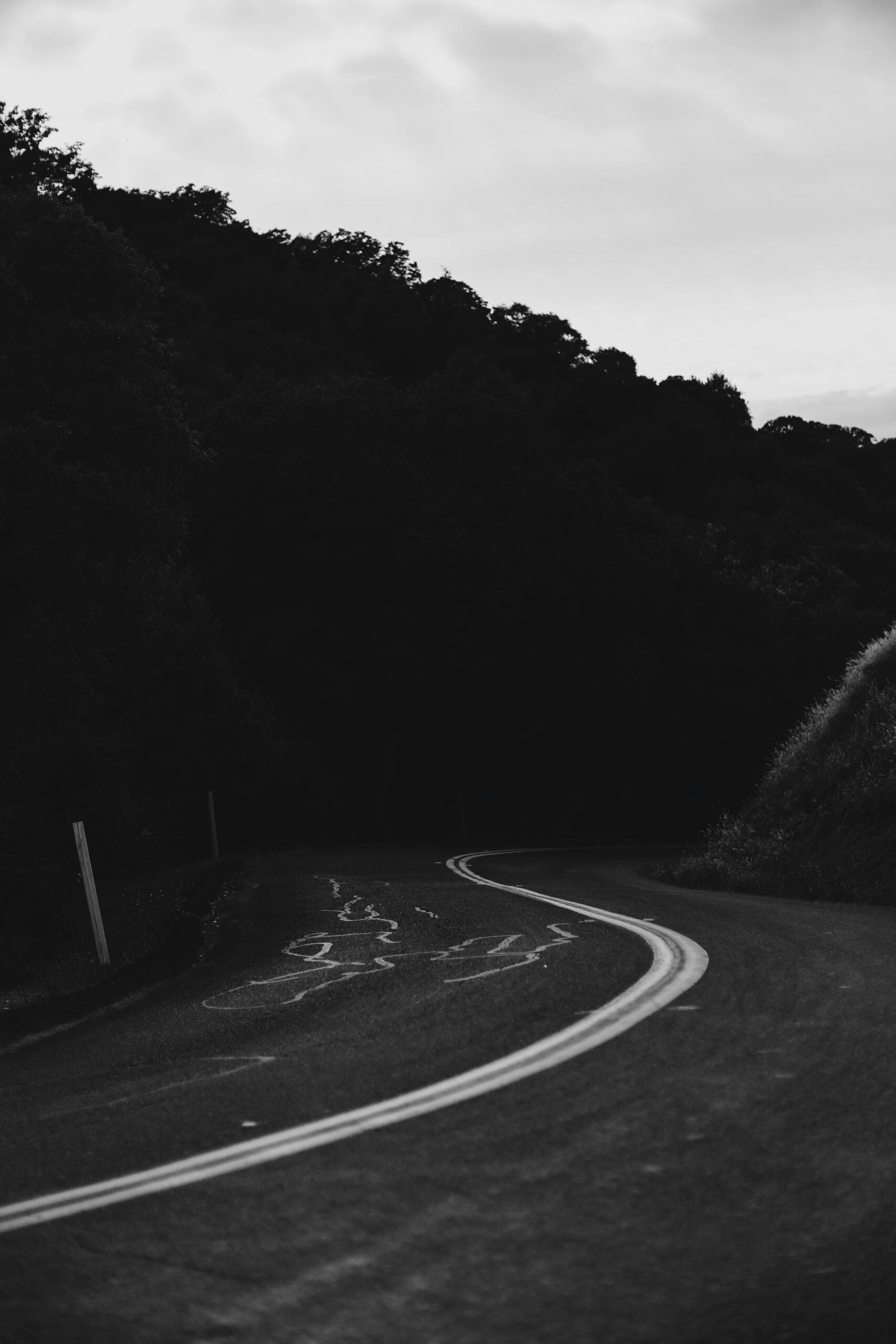


In summer, during the season, he works from sunrise to sunset. Drives to work at dawn, comes back at dusk. It’s beautiful; the drive takes exactly as long as the sun rising and setting. They set out together, they arrive together: the young man and the sun. Sadly, it’s always behind him – he drives west in the morning and back east in the evening. Of course he can tell from the way everything looks that the sun’s rising or setting, but he can only see the sun itself when it appears in his rear-view mirror. That’s how he drives, with his eyes on the mirrors. It shifts a few seconds and metres every day, but there are a few places where it’s always visible. After the bend, on the left, by the forest on top of the hill. In some places, it’s in two mirrors at the same time, and he’s dazzled for a second. Sometimes (quite often) he closes his eyes for an instant afterwards. One, two. Imagines it appearing in all three mirrors at once. It doesn’t have any meaning, he just likes imagining it. That’s not without its dangers – the roads are crowded both morning and evening – but still, he can’t help trusting that an accident won’t happen in those two seconds.
During the day, he sits inside. You can see the lake from the hotel reception desk. Not the water, but the reeds on the banks. The movement of the reeds, the reflection of the water behind them, the clouds above, the lack of clouds. That too is all beautiful. The summer is beautiful. It gets very hot, but the hotel has air conditioning. Then, when he leaves in the evening, he feels the heat stored in everything streaming out, and there it is again: the sun in the mirrors.
In winter, though, he sees almost only darkness. Drives to work in the dark, still as dark at the end of the drive as at the beginning, then he works, and drives back in the dark. A lot of people live that way. In the very beginning at the hotel, he had also only worked the night shift, that was how the job was advertised, seeking night receptionist, and he also wanted the 200 euros more they were offering, but then it did get too much. You just need more light, the doctor said. He mentioned the 200 euros. I see, the doctor said. In the end he did dare to ask his manager if he couldn’t at least sometimes have the day shift.
Giving up the constant night shifts could have benefitted his social life as well. He had a lot of friends, still has them actually, it was just that they barely saw each other because of the night shift. Before that, they used to get together almost every evening and play sports: pool, darts, bowling, badminton, and at the weekend football and tennis. They’d eat well too: pizza, burgers, toasted sandwiches, and shandy to drink. A happy, mixed group of boys and girls. He could have had all that back with the day shift, but somehow he didn’t get it back. I don’t know why. I don’t remember exactly when, maybe during the lonely nights behind the reception desk, sometimes standing outside the door to hear the rustle of the reeds and the lake, maybe it was during the sunrises and sunsets, but a silence moved into him, a silence he doesn’t have the heart to break. After work he drives home, lies down on his bed and reads poems, like he used to after school (and in fact he reads the same books from school, which he still has), but not always. The silence that has come to be is not always stable enough for him to let in words. Sometimes not even music. (The sound of the washing machine rarely bothers him though.) Then he spends the two or three hours before he goes to sleep concentrating on not letting it break. There are worse lives. But it’s obvious his friends don’t understand what’s the matter with him, and he couldn’t explain it either.
On the day when this story takes place, though, he could find no peace from beginning to end. First of all, he was almost drawn into an accident. The one-street village where he lives is on a hill, and his house on a bend in the road, which is particularly dangerous in winter when the road is iced over. Cars coming out of the bend from above slide directly towards his house. Fortunately, there’s a ditch in front, so no one’s ever crashed right into the house. For as long as he can remember, there have only been three crashes into the ditch. It’s summer now, but still, not knowing the place and occupied with the view, as tourists tend to be (even so, they could at least drive slowly, but no), someone ended up on the wrong side of the road that morning, right where he was driving out onto the road, still rather sleepy himself. Screeching tyres and wide eyes on both sides. Stood there, no more than a finger of air between the bumpers, both lanes blocked, for an eternal minute. Then they both reversed a little, not getting out of their cars, not saying a word, and drove past each other. So it had happened with the least possible effort, yet his heartbeat still hadn’t settled down by the time he got to the hotel.
Later, during his lunch break, his manager called him into her office.
To be brief (that’s what she always says: Hello, to be brief): You’re one of our best employees. Precise, concentrated, polite, loyal. I have absolute faith in you.
Thank you, he said.
To put it briefly, she wanted to ask him if he could imagine becoming head receptionist. Which had been her job to date, but now she’d be taking a step up. For him, it would mean responsibility for four members of staff and 350 euros more per month.
Thank you, he said. Can I sleep on it and get back to you tomorrow?
Of course, his manager said. Rather surprised (or perhaps already disappointed). Not because he’d asked for time to think it over, that really is a matter of course, but because he hadn’t showed a sign of emotion during the whole conversation. 350 is only 150 more than the night receptionist gets, but that came at the very end. Even before that: no surprise, no joy, no excitement, only his politeness, as always.
For the rest of his shift, he went outside every time his colleague came back from a cigarette break. Her: cigarette in one hand, phone in the other, organising her life outside the hotel, or simply living it, not stopping just because she’s at work, a cheerful girl with long hair and red lipstick. Their manager doesn’t like her texting, the girl’s attitude, nor the girl herself. He doesn’t judge either of them, he just doesn’t smoke or text, but also doesn’t have to inform anyone immediately or ask for advice this time either. He just stands there by the ashtray, his face to the lake, his hands in his pockets.
On his way home, the sun glowed more strongly than he’d ever seen before, sheathing everything in peony-pink light – in all three mirrors would have been nothing, compared to this flood. As though it were a giant current we never knew existed until it burst the banks. He had difficulties seeing anything and got very tired. But he couldn’t go straight home. He had a date.
She’s always too early, he’s often slightly late. He couldn’t go home and change his shirt; he had to go as he was, in his receptionist’s outfit, the tie stuffed into his chest pocket. I smell of sweat, of course. The jacket was on the back seat, and now that he had to take someone else in the car, he saw how messy it was. Mainly crumpled fast-food packaging and sweet wrappers. He was very hungry now too, but he picked her up first.
She was standing on the edge of the pavement in the now mild remaining light of the evening, wearing a short tight dress and high-heeled white sandals. As he approached her, drove the last few metres, a nearby streetlamp went on and her coppery hair lit up. She was beautiful and happy and rested, like she always is when he sees her. Whenever he sees her she’s on holiday and he’s working. She comes exactly once a year, in summer, and never for long. He can’t ever suggest anything, so she says when and where they’ll meet and what they’ll do. This time she said she wanted to go up the high viewing tower on the mountain (only a hill really, not even 400 metres high), the wooden monstrosity she remembers from her childhood. Many an involuntary excursion took her there (school and other adult things), and it grew more and more ruinous from one visit to the next: names carved into the walls, rusty nails, then the staircase blocked off. There’s apparently a new one now. Let’s go to the viewing tower and look down on the town by night.
Let’s get a sandwich first, he said. I’m starving.
He got himself a cheese-and-ham toasted sandwich from a snack bar.
You shouldn’t eat that rubbish. Shall we go to a restaurant instead? Or, unfortunately it only occurred to her now, she should have brought a picnic basket. An outing, a picnic basket. A picnic by night with a view of the town. That would have been nice. Why hadn’t she thought of it? It’s all badly planned; she takes the blame.
Never mind, he says. I have this now.
She couldn’t sit there and wait until he’d eaten, so she offered to drive. It was fine by him; he was very tired. He slumped low on the passenger seat, his knees pressed against the glove compartment, the greasy sandwich close to his mouth; all he had to do was bite. A piece of cheese fell on his shirt. He’ll never, ever get the grease out, the shirt’s ruined. Never mind. She drove the unfamiliar car jerkily, and fast as well; he felt the bends in his stomach. Her legs shone when she changed pedals. She was wearing sheer tights despite the heat. Shiny legs, shiny hair. She’s older than me and looks younger because she makes an effort and I don’t.
We don’t want to make a mystery of the relationship between the two of them, quite the opposite, we want to call the absurd situation by its name, which is that they’re half-siblings with the same father, and neither the father nor their mothers want them to see each other. She’s 33, he’s 30, and they meet secretly once a year in the town where they were both born. He lives in a village on the outskirts, in the same house as his father, now in early retirement, and she stays in town with her mother when she’s there. When they go out, they’re asked where they’re going and who with, so they say something; the price is nothing but a smile, but it’s still absurd. That’s why he always agrees to meet her, no matter how tired he is, no matter whether he actually had other plans with someone else (in the old days).
It was almost ten in the evening; theoretically it was dark, but a town is lit up, of course. They drove past the municipal park, through the too deep underpass that floods after heavy rain. The people who live on the hill have trouble getting into town then. The better-off live on the hill. The swimming pool, the tennis club and the town’s hotel with the most stars are there. There are no houses behind it, only the woods and the road to the viewing tower.
Do I turn off here?
But she’d already turned off. The road in the forest is no longer lit, it’s narrow, the surface rough, broken at the sides. She whistled a tune, Hansel and Gretel, and laughed.
So how are you? Are you OK? At work?
Yes, he said. I’m back on the day shift. (Still tired, but getting enough sleep. Doesn’t have to go without sleep to meet her now. Sleeping with his eyes open sitting on the grass at the edge of a bathing lake while wasps drown in the juice bottle and she turns her shining body to and fro in the sun.) It’s a lot more comfortable. Except you have to do more overtime. Like today, a group of Italians came just before the end of my shift and only spoke Italian. I had to stay because I’m the only one who has any Italian, but to be honest, it’s not up to much. It worked out somehow, but it didn’t go well. I only speak it like someone who can’t really speak it, now. And it used to be my favourite foreign language.
She consoled him – it wasn’t his fault if he couldn’t speak it with anyone here. Italians rarely come here. When were you last in Italy?
He was too tired to count back. A long time ago, that’s for sure. There must be a refresher course on CD I could listen to on my way to work.
He knew the instant he said it that he’d never get a CD. Whatever he starts, he always stops well before the end. He looked at his knuckles, suddenly remembering how he’d learned to cut vermicelli during one of his broken-off apprenticeships. The knife, the knuckles. That would be something else to check some time: whether I can still cut vermicelli.
The tower appeared on the right-hand side. It was made of pale, yellowish wood. A short forest path led up to it, as though there were also two wooden picnic tables with benches in the dark. She parked the car out on the road. In high-heeled sandals across a dark forest floor. She laughed at herself. It’s so wrong. After a while, their eyes got used to the darkness, and their feet also learned that the path was scattered with mulch, so they had no real need to fear stones or roots they might have tripped over. The trees creaked all around them, and there was a rustling in their crowns, although they could feel no wind. Dark rustling, too dark for everything; there was a new moon. The sister looked up. Where she lives it’s always very bright, she barely sees a couple of stars for most of the year. She’s used to there being very many here though. Except for that day; a few low white clouds, that was all.
They hadn’t yet reached the tower when they began to suspect it would be locked. But still, they couldn’t give up right away, they had to try it. Of course: locked. Wooden tower, wooden steps, barred iron door. And the scene around them wasn’t cosy enough either. Sit on the wooden train in the children’s playground? On the seesaw? Her: yes. If she were to say, come on, let’s go on the seesaw, he’d join in. He’d never suggest something like that himself. Getting on a seesaw with his sister in a pitch-black forest. But she didn’t suggest it. They got back in the car. Let’s just sit here for a while. It’s good to sit in the car and talk.
And again: What’s new? This time to her.
All the same as usual. The office she runs with her husband is going fine. Not much stress, and when then it’s productive stress. The children question is on the agenda, less of their own accord but because a lot of their friends are having babies. They haven’t decided yet. (She’s scared of getting ugly and unhappy. But she doesn’t say that to anyone but her husband.)
And how are your parents?
It’s her who asks, of course, because she wants to know what it’s like living with their father, but he mainly talks about his mother every time, who by now is also divorced from their father and then fell ill, is fighting to get incapacity benefits, moved in with a new man and moved out again and bought a car, but then she couldn’t pay the instalments so he sold his old car and took hers off her hands, now he pays the instalments and if she wants a lift anywhere he drives her, but she’s unhappy because he’s out all day, and someone of her age rarely wants to go anywhere at night.
She smiled. He forgot to tell her about their father, and he never asked her about her mother either. The woman their father had left to be with his mother. She’s fine, thanks, the sister thought. She’s healthy, has work and money and doesn’t have a husband who drinks or snores. The only thing that’s not allowed is reminding her of the husband she’s been divorced from for over thirty years, because then she goes into a rage and doesn’t calm down until I’ve spent a night somewhere else, and she’s relieved to see me the next day.
(We’ll survive them, she said to him last year.
Who knows, he said.)
And then what had happened that day: I’ve got a promotion.
Really?
That made her burn with enthusiasm. Her hands, hair, legs set in motion, everything about her lighting up. Promotions are good, making career progress is good, or at least ‘making something of yourself’. Taking opportunities, exhausting possibilities. Within existing circumstances or even beyond, creating new circumstances. That’s good!
He hadn’t really followed the part about the circumstances; as soon as he heard the word career, he realized he didn’t want it. He didn’t want to be head receptionist. To have four people below him and 350 euros more. Career. Even the word.
I’m not sure, he said, tentative. I’m not sure it’s worth all the stress.
She mentioned what she called positive stress again. There’s positive stress as well.
He nodded. Of course. Sure. I know.
(The swift change from one leisure activity to the next. Football kit off, shirt on, the others are waiting in the pool hall, there’s a girl there you know vaguely, who might be a possibility. He still thinks ‘girl’, even though they’re women by now. Some already have a marriage behind them. Some have a child or even two. It never got as far as him meeting those children.)
Maybe more stress is what you need, she said next to him.
Suddenly he got so angry he felt warm all over. He pressed his lips together. Remnants of greasy cheese on them. I’ve gone red, no doubt about that. My red face above the white shirt collar. Thirty years old. My hair’s already starting to recede.
She’s not absolutely insensitive; she waited until he’d calmed down. Looked out at the dark forest, bided her time, and only then did she ask:
What’s your dream, then? What would you really like to do?
(Nothing. Watch the sun rising and setting. I don’t want to live any longer than those few minutes of the day. Not have to eat, nothing. Sleep like a mythical creature. It sleeps, wakes up to watch the sun rising and setting, then it sleeps again. Over and over, forever.)
Out loud, he said (and only so his anger didn’t last too long, so he could keep talking with her): A sandwich bar. Like the place we just went to. Toasted sandwiches.
And she, of course, was instantly behind him. As enthusiastic as she always is. A sandwich bar, why not? It would be really good if it wasn’t one of those greasy spoons full of neon like the one they just drove to, of course, more like an Italian bar. With a good espresso machine, the kind you have to spend half an hour cleaning after closing time because that’s the only way to get good coffee out of them. And there’d be tramezzini, of course, or toasted sandwiches like he called them, but they’d be called tramezzini. And there’d be one kind with grilled vegetables in them, they’d call them tramezzini with antipasti. The few Italian tourists would come into the bar, and he could speak Italian with them. After a while word would get around, the Italians would tell other Italians, and at some point travelling Italians would take a special detour to the picturesque town; it’s worth a visit anyway. One day the town would even twin with an Italian town of a similar small size, the Italian men would fall in love with the local women, and the local men would fall in love with Italian women, including him, and I’d have Italian nieces and nephews.
She laughed again, and because she was so adorably shiny, her eyes, her lips, her cheeks, he stopped being angry and smiled a little too.
Or have you already got someone? (A woman, she meant.)
He stopped smiling and said: Not at the moment.
That’s a pity, she said and sighed. And then they both thought of someone called Andrea, who had been his girlfriend for seven years and was then even his fiancée before she left him.
She left him because he worked nights and slept during the day, barely said a word when he was awake, and spent most of the little time they’d have had together at his dependent parents’ beck and call, to say nothing of the money they always needed for this and that, medications, doctors’ certificates, repairs, consumer goods that proved absolutely useless, but never mind, even though it ate into his savings. What if we have kids one day?
At the time she had said she could understand Andrea’s standpoint.
He had said, and still says: A partner has to stand by you.
No matter what it is? No matter how long? And if it lasts forever?
It wouldn’t have lasted forever.
Seven years is a lot. And it would have been ten by now. And that’s just what’s behind us.
(She just wants to get back at our father because he wasn’t there for her, he thought. And he asked:) Can we change the subject?
They sat in the car in silence. Ten seconds, or twenty. In the darkness of the forest, the sky.
Then suddenly, out of nowhere, no, from below them, from the town, came the sound of a roaring, revving engine and a very bright light. It was a large vehicle heading towards them, they saw it, its lights, saw it heading straight for them, not just in their direction, but that must be just an optical illusion, it would drive past them, however quick and close. But that wasn’t what happened. Instead it came closer and closer, fast and loud, and before they realized it crashed into them with a murderous bang. It thrust them along, off the road. Not to where the mulch path leads to the tower, but beside it, onto the slope. The hand brake was on but they still slid, although the woman hit the brakes as her reflexes kicked in. They didn’t slide far, luckily; there was a tree in the way and they bumped into it and came to a stop. Above them, turned sideways on the road by the force of the collision, with its lights still beaming: a huge jeep.
The engine was still on when the driver leapt out. He shaded his eyes and called out: Hello?! But he stayed close to his car, didn’t come towards them, even turned away, walked around the jeep to the passenger’s side, opened the door and spoke to someone.
Everything OK? the sister asked her passenger. Are you hurt?
He wasn’t hurt. She wasn’t either. The doors still opened.
Hello?! the jeep driver called. Stood there like before, shading his eyes. Shaved head, white trousers, white T-shirt with some kind of writing on it. A cliché if ever there was one.
Can you turn off the lights? the sister called out. Turn off the lights! We can’t see anything!
The shaven-headed man switched off the engine and most of the lights, re-emerged from the car and shouted.
You were in the middle of the road! The middle of the road! No lights on! You must be crazy! No lights, in the middle of the road!
Is that the best you can do? The sister, shaking mulch and leaves out of her shoes. Can’t you see what’s happened to the car? You ask if anyone’s injured first.
Are you hurt?
Doesn’t look like it, no.
The jeep driver’s girlfriend still didn’t get out of the car, sat trembling behind the windscreen. The jeep driver called the police.
Now the young man got out of the car too. His side of it was hanging slightly lower down the slope; he had to prop himself up on the car to stand. He felt his way forward to look at the crash damage. The tree buried deep in the bonnet as though it had grown that way. Scrap metal. The car’s nothing but scrap metal.
Everything OK?
I have to drive it to work tomorrow, he said.
Are you insured?
Am I insured? he shouted. What do you think? Am I insured? Am I? Insured?
He moved hand over hand along the car, clawing into the slope, crawling on all fours up to the road; he reached it and stomped off down the hill.
She called out to him to wait, and the jeep driver shouted too, asked where he was going, said he ought to stay there, had to stay there, the police would be coming soon, but he, he kept running down towards the town. He can still run fast. He doesn’t practise any more, but still. His knees hurt after a while downhill, but never mind. In her heels, she hasn’t got a chance of ever catching him up, but she still tries. Up the slope on all fours, stepped on the edge of the asphalt and tipped over on her first step onto the road, got her balance and ran after him.
The jeep driver couldn’t believe it. What they were doing. That’s a hit and run. Are you out of your…?
Her high-heeled sandals on the steep road. Clopping at times, scuffing and stumbling. Until she started sliding so much that she slipped and fell. Her feet slid forwards and she landed on her behind. Felt her tights ripping on her bottom and her calves and the skin scraping. The back of her heels as well, of course. They’re fit for the bin, but the scratches on her skin are hardly worth mentioning. Tiny pebbles sticking and falling off again. Sat on the road, her skirt hitched up, and shouted for her brother. He was out of sight by then. But the jeep driver had set out in her direction. He wasn’t running, perhaps he just wanted to help. She kicked off her shoes as she sat there, picked them up, pulled herself together and went on running down the slope. The rough asphalt cut the soles of her feet but she wouldn’t really notice that until the next day. The jeep driver had stopped, maybe his girlfriend had called after him, told him not to leave her alone, maybe he’d just realised: there’s no point with them two.
She ran down to the junction with the main road. She’d stopped calling his name (he’s called Peter and she’s Petra, just imagine); she’d run out of breath. The road was brightly lit and empty, she pulled her dress back down far enough to cover her underwear. She left her shoes off and walked on down the hill that way.
She found him not far off, standing by the fence around the swimming pool. You can see the town a little from there too, but he wasn’t looking at the town but at the outside area of the swimming pool, closed for the night. Next to it is the tennis centre. He’d played in a place like it as a teenager. When he was still a hopeful young talent.
He was entirely immersed in watching the blue water. It’s blue because the walls of the pool are tiled in blue. Perhaps he’d forgotten her for a second; he certainly hadn’t heard her for a while. He didn’t see her until she stopped right next to him, clutching her shoes in one hand. On the road behind them, two police cars drove up the hill.
(You’re just luckier, he thought. You’re just luckier. Of course no one can blame you for that, but on the other hand it’s easy for you to talk.)
I can lend you money, she said. Not that much, but something.
No need. I can use my cousin’s moped for a while.
(The sunrise on that moped.)
What time is it?
Not quite eleven.
(Seven hours to go.)
Your shirt’s torn.
(It is. How did that happen? Never mind. It was ruined anyway. Tramezzini prosciutto formaggio.) Never mind, he said out loud. It’s only a thing.
He looked at her as she stood there, her tights torn, her hands dirty. She still looked radiant nonetheless. Groomed, rested. He wasn’t angry with her. What for? She was just a stranger to him. (Sorry, but that’s how it is. I wish I had someone who’s like me.)
It’ll be alright, he said. I’m only thirty. I’ve got my best years ahead of me.
He said it with a smile because the thought of the next morning’s sun in the mirror of the moped had made him calm enough to realize the two of them had nothing in common, and having realized that made him free enough to forgive her. Although there was really nothing to forgive.
He said: I’d better go back up.
She said: I’ll come with you.
Don’t you want to put your shoes back on?
This story is taken from: Liebe unter Aliens by Terézia Mora
© 2016 Luchterhand Literaturverlag, München, in der Verlagsgruppe Random House GmbH


Comments