



Read in:
English


Instruction Manual (Before You Listen)
Low light, half-light, no light: light again.
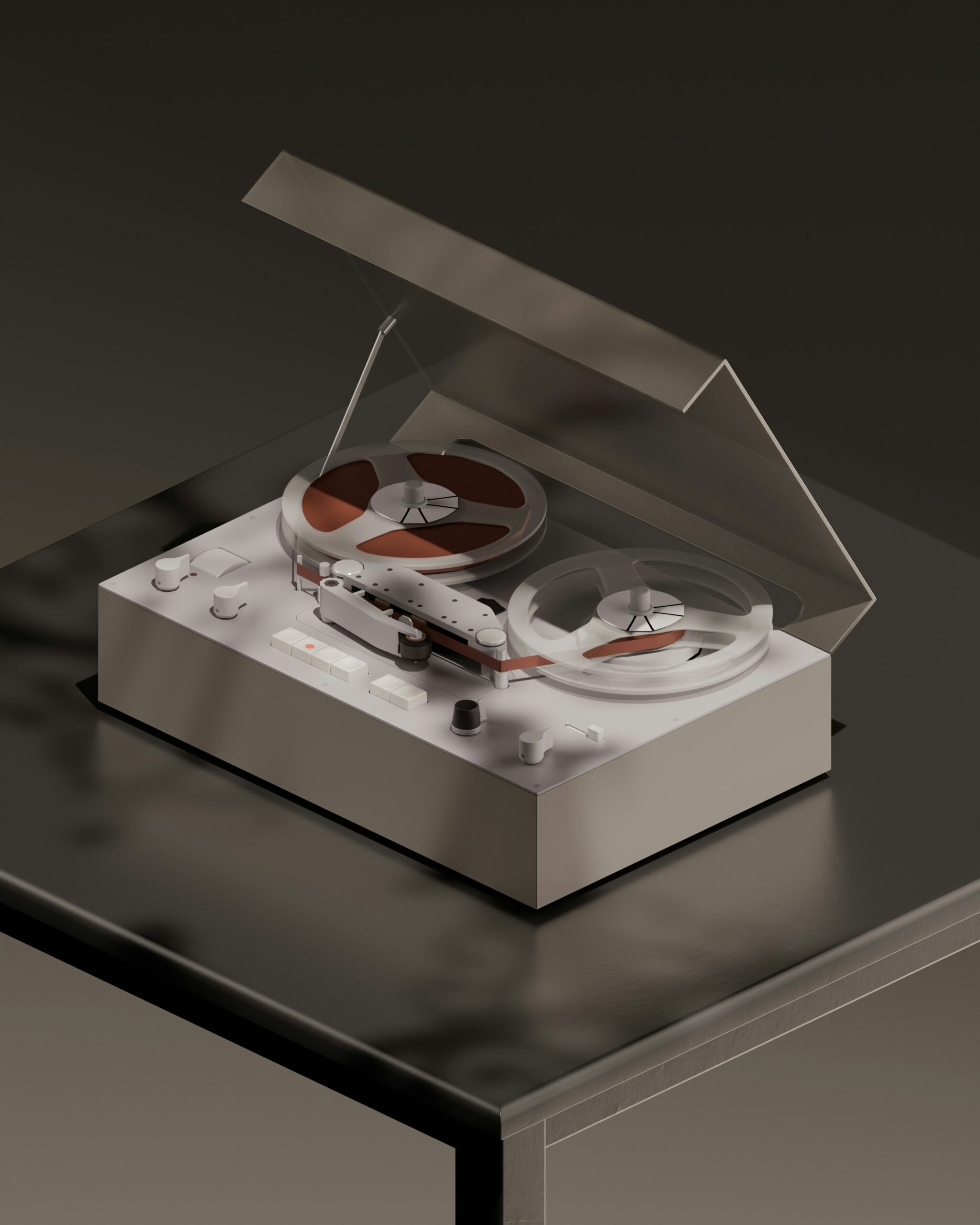
This is how you prepare the room. First, remove what speaks. Unplug, disconnect, absent: all of it. Don’t turn the Machine on. It has already started. It’s been listening for hours. Days. Years. Elastic moments enveloping. It began before you entered. Later, it won’t stop.
Draw the curtains. Close the door, not once but twice: first against what speaks, then against what listens. Let the floor be gone. Let the air go dark. Wait. Sit: not where you always sit: somewhere, the silence bruises deeper.
Wear something that remembers. Tradition only in that it passed through hands: a shirt someone once unbuttoned slowly, without speaking. A scarf laced with perfume still clinging to the silk. Jacket pockets full of cash, foreign coins, the ticket for the train you never caught. Motions by which loss may be known.
The space between your fingers must be empty. The space behind your eyes must be full.
The Machine takes no memory. Feed it nothing. You give it only approximation: a taste lingering at the back of the throat, almost breath. A street name half-forgotten. A thumbnail of ache. It will do the rest. It will extract the sound of forgetting from your silence.
The Machine runs on salted water and filament. It hums beneath Sarajevo like a second heart, pumping sorrow into the city’s bones. It requires maintenance every third Thursday; twice a year, it must hear a door closing in an empty apartment. Recordings are encoded into its motherboard like a psalm in binary, matching our heartbreaks to melodies we must remember though we never heard them.
It is not a jukebox. Not a séance. Not quite a theft. It is a translation of what never happened into what might be heard.
It will not play what happened. It will play the sound of you trying to remember another life. The exact pitch of your failure.
Play the final track once. The Machine records each listening. It knows if you return. It alters the algorithm: a different absence each time. No two griefs occupy the same frequency.
You may hear static. You may hear breath. You may hear the sound distorted through the riptide of another’s grief. You may hear silence. You will not hear what you listen for.
If it glitches, don’t touch it. The past caught in its teeth. A faint pull, like the hem of your coat touched by a stranger as you step into the street. Memory has corners. The needle finds them. Things clarify, roll on.
There is no right listening. There is enduring what returns, then goes. Wait.
Low light, half-light, no light: light again.
Here is what it chose for me.
Side A
Track One: Where Water Meets Sky
Recording Date: Unknown
Duration: 3:58
Playback: Seamless loop functionality between last word and first glance. Optimal at dusk.
Technical Details: Headphone playback produces vertigo effect at tonal inversion point (1:49).
Composition: The piece begins with a field recording of late summer lake water, unnaturally still. Above, a spectral glissando (instrument disputed—violin, or possibly an opera vocalist practicing scales through an open window). The ascending notes never resolve, only climb and dissipate.
Machine Effects: The Machine has rendered sky and water sonically indistinguishable. What was reflection becomes origin, honey before the bee, before the flower. The track captures not the departure but the hesitation preceding it—the moment before the moment.
User Memory: You never said goodbye. No language for it existed between you. You walked beside the lake after sunset. Towers to the west tossed across the water’s obsidian surface. A silence opened between you, wide enough to fall through. Birds rose in unison. Her shoulder turned at the precise angle that meant finality. Somewhere above the street, a vocalist climbed a scale she would not resolve.
Interpretation: The loop preserves the almost. She is perpetually turning away. You are perpetually failing to speak. The opera singer climbs toward a note she will never reach. The Machine doesn’t replay conversation but preserves the negative space where words should have been. It loops what preceded recognition—an unbearable, unresolved suspension. When the track plays, lake water beads again on your skin. You feel the temperature drop. You stayed even though your jacket was too light. The Machine records the exact pitch of your silence: amber, no melisma.
Track Two: Requital Loop (B Minor)
Recording Date: Unknown
Duration: ∞
Playback: Glitch present. Corruption. Lag toward dawn.
Technical Details: Recursive. Self-referential sonic looping. Track will not conclude. Manual fade recommended.
Composition: The track opens with a slow progression of minor chords, mostly unresolved. At 1:32, a phrase enters: I am still here. Whispered, but clear, not faint. Then it begins to harmonise with a sampled lyric—Djelem, djelem. The two phrases overlap without ever aligning, voices in parallel grief. The result does not align dissonances or dissolve harmonies. Instead, the sound of two ghosts trying to occupy the same mouth. At 2:10, the Machine attempts tonal merger. Failure. The phrases loop independently. Then they loop out of sync. Then they fracture. Glitch opens. Static blooms. Memory freezes. Language unravels into hum.
Machine Effects: What begins as musical acknowledgment degrades into recursive lament. The Machine cannot resolve the contradiction: to remember someone who forgot you. The loop extends forever, not because the moment matters, but because the ending was never given. What emerges is not a song but a failure to stop.
User Memory: He made you songs. You never listened. You still don’t know what he wanted you to hear. Instead you remember a silence: the space between two people trying to love each other in the wrong ways. You told yourself you’d ask. You didn’t ask. Then he was gone. The songs remain, unheard, trapped in a database whose password you cannot recover. Now the Machine has rendered the absence of listening into endless sound.
Interpretation: Requital is fantasy. What returns is not what was sent. The track is not a consolation. It haunts. It plays what you didn’t say back to you in the voice you never used. It plays the ache of never having asked, unmerged. Each loop becomes less human. By the fiftieth repetition, the Machine is exhausted. It begins to insert ambient noise: a sigh. A footstep on tile. The click of a door that never closed, opening to no one there. Eventually the words dissolve, leaving only their rhythm. Your grief now set to meter. Not melody. Just measure. A reminder: the time signature for longing has no bottom number.
Track Three: Zinnia Bloom Algorithm
Recording Date: Unindexed
Duration: 3:16
Playback: Single play only.
Technical Details: Low-level harmonic decay. Melodic structure degenerates on repeat. Playback not recommended more than once per listener lifespan.
Composition: The track opens with a delicate five-note motif played on an mbira, slightly detuned. There is breath beneath it—possibly real breath, recorded in an attic or a basement, or the simulation of breath modelled from archival footage. At 0:46, a violin enters, sharp and spare. The melody stumbles once, continues. A lullaby tries to emerge but fails. Its bars are missing. Its key is indeterminate. At 2:14, a swell of strings arrives—brief—and then cuts away as if ashamed.
Machine Effects: The Machine has reconstructed a grief that was never yours. It has built the track from genetic material, ancestral echo, the neural weather of your mother’s hands. In early testing, listeners reported phantom pain in the arms. One noted the sensation of a child being carried in reverse. This effect has not been explained. The zinnia motif—fragile, wilting, resilient—threads through the five-note mbira pattern like sunlight across brittle petals: bright at first, then fractured. Each note lands with the weight of something already fallen. Mid-track, the motif splinters into overtones—delicate and vegetal, tending toward metallic at the margins—until it vanishes, leaving behind a ghost-scent of pollen and static, the sonic equivalent of a flower forgetting how to bloom. When played through speakers, the space around the listener warms by one to two degrees. When played through headphones, the smell of lavender or singed dust appears.
User Memory: A wedding photograph (not yours), blurred at the corners. Her dress (not yours) was white, borrowed. The bouquet already wilted. She was nineteen. Maybe younger. He didn’t know how to say her name when they signed the license. You weren’t born yet, but you were there. In the silence. In the hand she kept on her abdomen, the one the Machine seems to remember even if you don’t. It is not your sorrow. But it is encoded in the hands you use to hold people. You’ve held them carefully all your life. You never knew why.
Interpretation: Some pain predates language. The Machine renders it as absence: the lullaby without cradle, the vows recited to no one, the violin playing for a child who would never fall asleep. What it can’t reproduce, it simulates. What it can’t simulate, it surrounds in static and leaves open. You are listening to what shaped you before you were visible. You are hearing the melody of your own outline. The zinnia motif wilts deliberately. There is no climax. No key change. Just a series of small, deliberate falls. You cannot loop it. Some griefs are inherited like bone structure. Others, like silence.
Interlude: Šaban, Speak
Šaban, are you in here?
I don’t mean to summon you; I didn’t mean to make you. I fed the Machine a memory of a winter train ride through Croatia—dull, abeyant, a half-snowed landscape, a plastic cup of coffee on a fold-out tray. It was not mine. No one spoke. Then I heard you. Just there, behind the chords, behind the hiss, time’s face behind the memory itself, like an afterimage of a dream that fades on waking or a scent of flowers untraceable but for the path to someone else’s memory of it.
No, I didn’t hear you. It wasn’t you I heard; someone else, another voice. But it was the shape of your aching: sclerotic back, arthritic knees, fingerprint in steam. The track had no vocals. No one sang. Then that long, slurred syllable of you pouring sorrow into time’s lame residue, like honey down the cracked wall of a well.
It keeps happening. I’ll be listening to a memory of someone else—someone who never knew you, someone who won’t remember this crux of geography, this twisted longing place—and you emerge. Always in the gaps, the dissonance. Where we need the sweetness most.
I heard you left the army for love. A deserter. Three years in Goli Otok for a woman. That’s the story the Machine desires. It loves men who sing to stones, making them cry for mercy.
You died poor, unremembering, apart. Your children do not respect you: that is our doom. The last record was never pressed, never heard. A kind of oblivion that writes your name in gold, the sunken splendour. No throne, just breath, voice, myth.
You are the negative space. The air between tracks, the wait. You are what the Machine plays when it doesn’t know what else to say.
There are days I remember a winter train ride through Croatia and I wonder if you are operating the Machine: from inside, unseen, your forgotten name selecting our sorrows, matching each ache with a minor third and a hushed brush lolling on a drum. Echoes we can’t trace because we do not remember a winter train ride, nor any kings.
Other days I think the Machine wants to bring you back. Like she needed me, it needs you.
I should be scared. I am not. I like knowing you may be there, looped and folded into the static. Yours is the only voice the Machine leaves be: the Machine desires, too.
Sing through me, Šaban. If sorrow must have shape, it’s yours.
Side B: Instructions for Listening Alone
Listen only at the hour when streetlights hesitate. When the day has not yet gone but can no longer justify its presence. The hour of failed metaphors.
Understand you are already listening. The Machine began its work long before the songs. Before you entered the room. Maybe before you were made.
Drink nothing. Not before. Not during. The Machine prefers a state of dehydration; it works best in the desert of your mind. If there is crying, do not wipe away tears. The Machine runs on saltwater and filament. Each drop contributes to its precision.
Place your hands palm-up on your thighs. Keep them empty. The Machine knows what they’ve held. What they’ve dropped. What slipped through. This is not about grasping.
You may speak to the songs. They will not respond. The Machine understands the virtue of no-reply.
Should you hear someone else breathing, continue. This is the Machine’s internal calibration. The ghost in its circuitry. It is not Šaban. It is not the person you lost, you. It is the sound of remembering, neither accurate nor false.
Track Four does not appear in the archive. It announces itself only in fragments—drumbrush on velvet, a moan behind static, the low vowel of Šaban’s ghost looping through an abandoned scale. Some say it begins with silence; others, with footsteps on gravel. The Machine flickers, hesitates. One listener remembers it as a song withdrawing from itself, shaped by someone who has loved too often to trust coherence. If Šaban lingers anywhere, it is here: in the glitch, improvising sorrow by touch alone.
If Track Four begins to stutter—good. The Machine discovers the fault line in your memory. It excavates the moment where narrative collapsed. Where you began to lie to, invent yourself. Stay with it. The glitch approximates truth.
Some listeners have reported a burning sensation behind the skull. Others taste metal in their toes. Others smell a perfume they cannot identify, though it fills them with a specified longing. These are not side effects, they are the primary function.
When it ends—it will end—sit motionless. Count backwards from eighteen. This is not ritual but time required for the Machine to disengage from your nervous system. Other, lesser numbers are fatal signs.
You will want to return immediately. You will want to live inside the loss the Machine has defined for you. You will want to hear Šaban, over and over. Resist. Wait seven days, minimum. The Machine recalibrates to your specific injuries. It learns where the needle hurts most.
Before leaving, touch nothing. The room conforms to the archive. Your posture, the temperature of your skin, your rate of breathing: all have been logged for future retrieval. The next listener hears fragments of your attention mixed with their own failure to remember.
Go home. If someone asks what you heard, say: the Machine remembers what we don’t.
In time you will come to understand: the Machine is not a device for recollection. It is our instrument of mercy. What it plays is not what happened but what you would have heard, had anyone been listening.
Coda: Track Zero
Recording Date: Indeterminate. Possibly tomorrow.
Duration: Undocumented. Variable. Depending. Who’s listening?
Playback: After silence has reabsorbed the room.
A track you didn’t request appears. No file name. No metadata. Only a pulse, a faint disturbance in the static like someone breathing through gauze.
The needle returns without command. The Machine exhales what it was holding. What emerges is not quite sound; instead, the negative space where sound should be. A reverse-engineered absence. Like honey at the bottom of a well.
Wind through empty streets. Then footsteps walking away from doors that never opened. Your own pulse turns audible, syncopated against the Machine’s rhythm. It has found the gap between heartbeats, the intermittency where absence lives.
The track begins to devour itself. It rewinds, accelerates, collapses. It rushes through fragments of what came before—lake water, the five-note mbira, the whispered I am still here, the ghost-voice singing Djelem, djelem. The Machine is sifting memory, searching for something lost.
A door opens. Not in the recording. In the room with you. The sound is so clear you turn to look. No one there.
The Machine has found what it wanted. Not grief. Not memory. But the space after both, where something new might begin.
Šaban’s voice rises briefly from the static—no longer trapped inside the circuitry but departing, a bird from an open hand. Djelem, djelem—I travelled, I went. The Machine has released him, or he has freed himself. His final note holds, bends, dissolves into air.
Something shifts in the mechanism. A new circuit completes, coheres. What follows is not music, but its possibility. Not remembering, but the space its absence clears for you.
The record stops. You hear the world again.
It is out of tune. It is yours.
“The Sevdah Machine” was first published in Half Mystic Journal, Opus II, Issue II: Sevdah (July 2025).








Comments