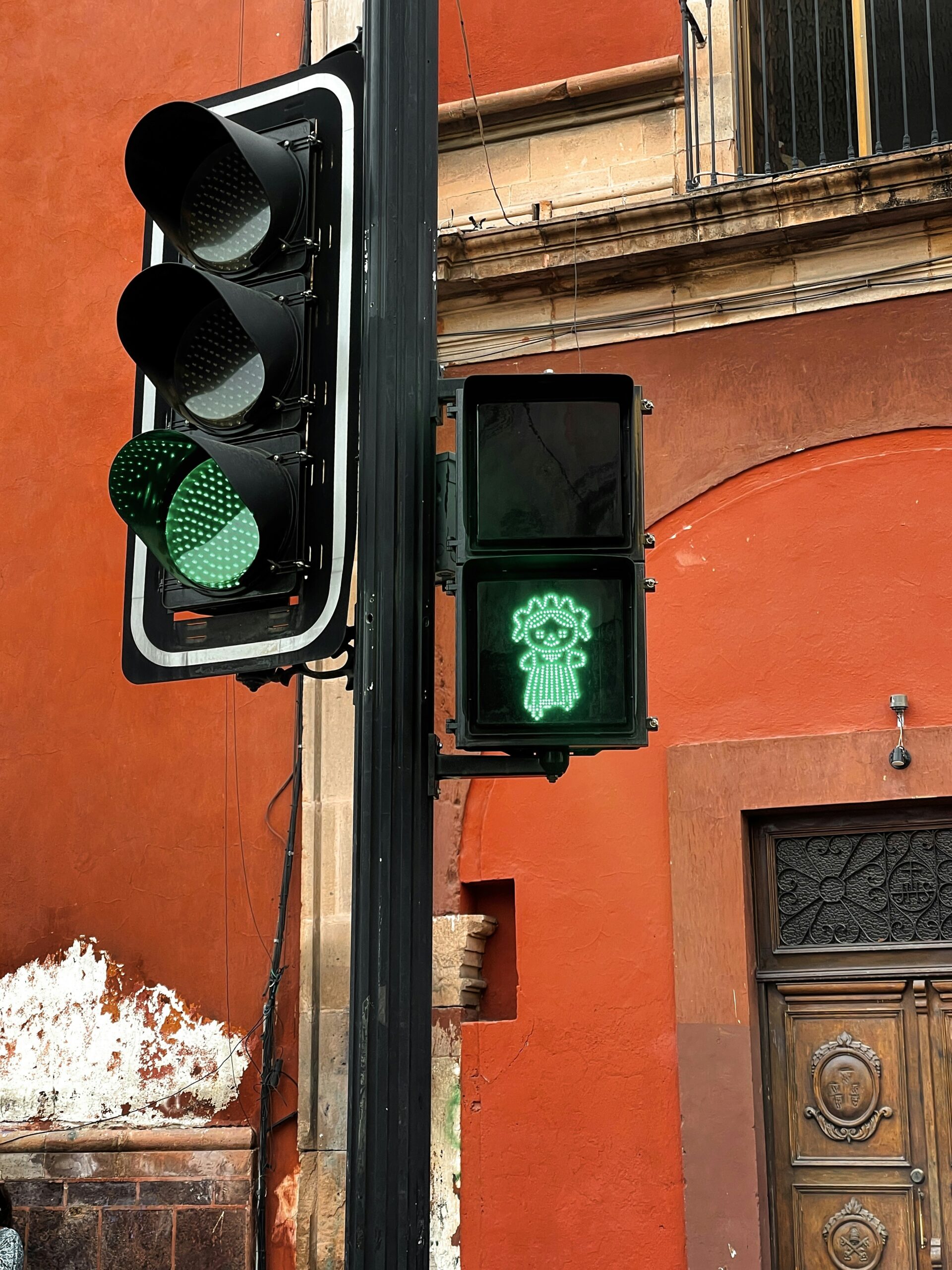


History pursues the truth through facts; fiction juices those facts until it is possible to extract their truthfulness. The story of Henry Eisenberg Glantz (1959-2020), alias El Santo Judío, a Mexican Jew whose life is the stuff of myth on the U.S.-Mexican border, is surrounded in controversy. An idiot savant, “Hershele” was the child of an Auschwitz survivor and the grandchild of an important Yiddish poet. Obsessed with urban planning, he was particularly interested in the role traffic lights might play in easing vehicular fluency. He coined the now-ubiquitous term “vialidad,” a metaphor for metropolitan dynamism. After entering and abruptly exiting Mexico City’s political establishment, Hershele moved to Tijuana, where he became a successful radio host. In time, he metamorphosed into an associate of the Sinaloa Cartel with influence to commit crimes whose ultimate goal was “to bring justice to earth.” As this “false profile” suggests, at the core of Hershele’s quest was the redemption of the “caged” children of Central American immigrants imprisoned in warehouses by the Trump Administration—“‘los pequeños que los nazis siguen acribillando,’ the little people the Nazis are still massacring.” There is a petition to beatify Hershele being considered by the Vatican.
Read in:
English


For Ada Skromne
“Don’t look up to heaven, for what will you see in the sky except stars, luminous but cold, wholly insensitive to pity?”
—Itzjok Leib Peretz, “Three Gifts” (1915)
1.
Shlemiel Segundo
Every life in retrospect is easily dividable into parts. Hershele’s might be said to have had almost symmetrical halves. The first half, from his birth in 1959 to the age of twenty-five, when he left Mexico City, was a period that served him as an incubator of the ideals that would later on defined him. The realization that his father was an Auschwitz survivor, for instance, transformed him deeply. And, unlike the rest of us, the love he developed for the country that opened its doors to Jewish immigrants was incommensurable; I, for one, never experienced such love. In any case, that period resembles an ascent. Then there’s the second half, with Tijuana as its principal stage, lasting until Hershele’s death in 2020. That half feels like a descent into purgatory. He settled in the border more by accident than anything else and grew to become an icon only to fall colossally from grace.
I confess to a reluctance to write about him. It isn’t, of course, that there’s a scarcity of material about him. Just the opposite. But, as in any myth, that material tends to be based on lies that he planted or deliberate misinformation by his detractors. My challenge is more daunting, as well as morally abstruse. I want to call attention to his motivations: how, as the son of an Auschwitz survivor, he came to be involved—if what the media suggests is true—with the Sinaloa Cartel in the sale of Fentanyl and arms across the U.S.-Mexican border; the way he used his own fame and a sophisticated secret code in an illegal ring to “rescue” caged children; and how, almost in spite of himself, there is a vigorous movement to beatify him, to make Hershele a pal of Mother Teresa.
His story doesn’t bode well for la comunidad, as Mexican Jews call themselves. I’m personally guilty of not having acted in time; that, in fact, might have been what prompted me, decades later, to reconnect with him. In writing about his “dreamscape,” not his actions per se but his motivation behind them. Frankly, I fear reawakening the antisemitic hatred that manifested itself when the scandal took place. No need for more swastikas. Yet not writing, that is, opting for silence, is an offense too. Schopenhauer believed that the basis of morality is compassion and that compassion, to exist, must give “proof of evidence.”
Hershele—his passport name was Henry Eisenberg Glantz, but I and everyone else in our “ghetto” knew him as Hershele, Yiddish for Little Henry—and I were neighbors. We were also “cousins.” We attended middle-school together in Mexico City, which means that for several years in the seventies, we rode the same school bus, back and forth, forty-five minutes each way, between Copilco, where we lived, and Colonia del Valle, the location of our shule, the Yiddish day school our parents enrolled us in. We spent generous time in Parque Margain, the green right in front of his house. Still, aside from these and a few religious occasions like the breaking of Yom Kippur fast, or playing dreidel on Chanukah, our encounters, I remember, were sporadic.
All this to say that, as much as I have dogged into his motivations, I still believe I barely knew him. Perhaps that’s because every human being at the core is inscrutable. In later years, when Hershele and I were already adults—he in Tijuana, I on the other end of the continent, in Miami—we didn’t see each other. Actually, we met only once, in 2018, when I happened to be passing through San Diego and, out of the blue, I reached out to him. He kindly responded, and, without much of a plan, a few days later, there I was, crossing the border, back to my native Mexico.
He was tall, slim, and brassy, with an unfashionable set of thick glasses. At any point when he would talk to you, his cheeks would turn red and he would start coughing. Maybe this was the result of anxiety attacks. In any case, he would instantly apologize, as if it had been all his fault, and would quickly disappear, suddenly and without a trace. Whereas the rest of us boys were obsessed with our appearance, especially our haircuts, which we wanted á la Enrique Guzmán, the famous Mexican pop singer, for Hershele appearances weren’t a nuisance. The least he thought about them, the better. He spoke clearly and with intent; I mean this in regard to the prevalent “youth slang” of the time, prone to expression such as carnal and gūey for pal and jackass, and puta madre for either what’s kindhearted or distinctively uncool. Hershele preferred a more dignified speech that inevitably sounded snooty. He would say dignatarios, instead of políticos.
By the time he became a staple of the nation’s airwaves in Señor Semáforo, his tongue more than relaxed, he was a model of lucidity and warmth, reflecting perfectly well the country’s own zeitgeist. Mexico lived inside him, the way it did on Carlos Monsiváis, whom he adored. He believed Mexicans used their sense of humor to cheat death (torear a la muerte) and to escape the obligation to act ethically. When it was convenient, he was celebrated among the intelligentsia for his lengua florida, the versatile tongue; and then, of course, as soon as he became a casualty, the highbrows replaced him, irreproachably, for another fashionable cause. Psychologically, he was gullible. I admit to have wondered, over time, if he was on the spectrum. The term Asperger’s wasn’t in our lexicon then; nowadays its application is so wide, anyone slightly awkward has a spot at it. I don’t think Hershele had Asperger’s; it might be that he read emotions too well.
What really tickled Hershele was an insatiable hunger to understand how human traffic works. I say this in concrete, as well as metaphorical, terms. He coined the concept of vialidad (roughly translated as “urban fluidity” and a metaphor for “metropolitan dynamism”), which wasn’t only adopted by urban planners but became ubiquitous wherever the Spanish language is used. At heart, he was a hopeless optimist. “The world we inhabit isn’t confusing because it lacks meaning,” he wrote me in an email: “It lacks meaning because we don’t see its true potential.” Once, when a theater teacher at the shule made us stage a “Mexican” version of the play Shlemiel the First, in which a few of us appeared in mariachi suits, a couple of classmates proposed him for the leading role. He wasn’t interested, and the teacher ignored them. Still, the moniker “Shlemiel Segundo’ (Shlemiel the Second) stuck.
Not just in Tijuana but in small serpentine towns along the border, dozens of altares and a statue in honor of Hershele’s memory. Half a dozen hagiographies have already been published about him. In spite of their concerted agenda—to cherish El Santo Judío without nuances and, likewise, without reservations—it would be absurd on my part not to recommend them. That Hershele reached such heights and lows is the source of fascinaton, no matter the conflicted emotions he may awaken. (Spinoza, in The Ethics, argues that emotions never come pure.) Remember: nothing comes ex nihilo, including saints, who are nothing but sinners behind whom there’s a good publicity team.
Is it dangerous to talk about lies, perfidy, duplicity, and self-loathing in a person who millions now consider a saint? Did Hershele himself understand what he was doing? How to make compatible the adoration he got from his milieu with the outright rejection from his tribe that goes on to this day? Is it possible not to describe him as naïve, wanting at all costs to do good, looking at life as “a problem to be solved”? Yet not offering a counter voice, whatever the consequences might be, amounts, in my view, to an act of dehumanization. This, hence, isn’t another panegyric but a false profile. If I’m accused of naivete and maybe of being an apologist of evil, so be it. I’m not after the facts; what matters to me is the truthfulness of things. Reality is an unreliable narrator.
2.
Is God a Sadist?
Mexico City, after the Tlatelolco and Corpus Christi massacres in 1968 and 1971 against student protesters, and in the tense last years of the Echeverría regime in the mid-seventies, marked by aggressive economic growth as well as merciless authoritarianism, was a brewing metropolis in a vertiginous drive toward expansion at all costs. Copilco had been built on rocky terrain on the hills of the Ajusco, a volcano known for intermittently spitting smoke over the tentative huts that populated its outskirts. Hershele once told me that before the Spaniards arrived, in 1519, the place had been an important ceremonial center at the shores of Lake Texcoco. It was home to the Chichimecas. They spoke Nahuatl. According to archeological findings made in 1917 by Manuel Gamio, a famous anthropologist, a smaller volcano, Xitle, had erupted in the fourth century, destroying the ceremonial center and dispersing the Chichimecas to Toluca and other places near and far. A priest accompanying Hernán Cortés was said to have been visited by an angel. This inspired the Spaniards to called the larger area Pedregal de San Ángel, the Holy Angel’s Stone Ground.
Modernity was everywhere in the late fifties in Mexico, when our parents, Hershele’s and mine, bought land in Copilco. In Coyoacán, a nearby neighborhood where León Trotsky had been assassinated, colonial buildings were being reshaped to fit an American model of “contemporary living.” Copilco, just a few miles south, caught another bug. Since it was adjacent to the national university, the objective was to turn a barren scene into an intellectual hub. A supermarket chain was persuaded to open a store. Banks came in. Cafés opened up. Then came a pharmacy, a car shop, a childcare center. A hamburger joint. A small theater. The offices of a publishing house. A music store. A bookstore that sold Marxist literature. Our street, Calle Odontología, had an unusual shape. It was a tributary of Avenida Copilco, a pleasant drive with magisterial árboles de tule. Across the street from Hershele’s house was a small park, called Parque Hugo B. Margain. The street then forked, leading in one direction to a dead end that housed an avant-garde movie theater known by its acronym, C.U.C., and on the other twisting around to return to Avenida Universidad. Hershele’s house was right in front of the park; mine was almost exactly behind it.
I called Copilco a “ghetto.” It really wasn’t, though it felt to us like one. Since his father and mine were artists, Copilco was the perfect place to live, far away from the real “Jewish ghetto” (Polanco, and Tecamachalco), yet a bus ride away from the Yshule, which was the compromise our parents were willing to make us different while also teaching us how to remain part of the tribe. There was a rebbe in our genealogical tree, Reb Shmulnik of Klopstock, whose Hasidic court was known for its mysticism. Shabbat, Reb Schmulnik was prone to give sermons on the Shekhinah, the female side of the divine, joyfully visiting its children, the Jews. The Shabbat candles, he said, were “kisses from heaven.” When we were boys, Hershele and I felt like the direct inheritors of Reb Shmulnik’s traditions in the New World. We imagined ourselves as newly-minted “Mexican” Hasidic masters, telling tales of wisdom and stories about dybbuks, golems, and other imaginary figures to our pupils. As it turns out, he did end up fostering a school of followers.
Somehow, as I look back, I can see Hershele only in our middle-school years. Was he at the shule before? To verify information—again, I’m not a historian—after his death I tried calling his siblings, Fany, Efraín, and Jane. (He was the third in line.) None of them wanted to talk, not to me and not to anyone else. Unfortunately, barely enough people showed up to make a minyan. The only one who responded to my texts was Fany, but in cursory fashion. She only thanked me for expressing my condolences. Any subsequent questions I sent went unanswered.
Few of Hershele’s devotees know that he spoke Yiddish. Di mame loshn was an essential component in our everyday life when we were young. That’s why Copilco felt like a ghetto. Instruction at our shule was in Yiddish. Remote as it from the headquarters of Jewish culture in Mexico City, Copilco was, for our families, a habitat devoted to the language of Sholem Aleichem and Isaac Bashevis Singer. Most of us youngsters used Yiddish half-heartedly, mostly to satisfy our elders. In truth, we disliked it thoroughly. Why on earth would the elders teach us a tongue that, for all practical reasons, was on its way out? The Nazis had pushed it into the ovens. Israel, half across the world, was a most vigorous young nation. Wouldn’t it be better to learn Hebrew instead, which, unlike Yiddish, had a future? Indeed, as we approached entering high school it became clear, among the administrators of the shule, that as Yiddish teachers retired, they would be replaced by shlikhim, Hebrew teachers being brought from Tel-Aviv and elsewhere in Jerusalem. In other words, we adolescents were right. Teaching us Yiddish had been a mistake.
I said before that Hershele and I were “cousins.” His father, Abel Eisenberg, had been the only child in in the Warsaw neighborhood where my great grandmother came from. I don’t exactly know how but Abel became an orphan when he was little. My great grandmother secretly adopted Abel. Not a word was said about it, since orphans were seen as lesser people. Thus, I was always told Abel was my grand uncle, which meant that Hershele was my second cousin—in Spanish, “mi primo político.” Abel grew up to become a renowned orchestra conductor. He collaborated with international musicians such as Dimitri Shostakovich and Arthur Rubinstein. He held conductor’s positions in orchestras in Havana and Santo Domingo; he also led the Orquesta Sinfónica de Guadalajara. He was on tour for long stretches of time. My mother was the one who eventually told me that Abel was an Auschwitz survivor. He had been imprisoned in the camp for several months and survived by hiding himself in a latrine. The reason no one knew about it is that the family feared the episode could undermine his career opportunities. Hersehele and his three siblings didn’t know either. They found out in 1975, when we all watched at the shule a French documentary about the Holocaust, Alain Resnais’ Night and Fog. It was our first exposure to photos of corpses, piles of glasses and shoes, and, next to them, soap bars. I recall talking on the bus about the images.
Next morning, he looked dazzled. The night before his father had described to him the smell of the latrines, the joy the day the camp was liberated, and other memories. Hershele punctuated his description with a question: Is God a sadist?”
3.
Three Chichimeca Children
Lilly Glantz, his mother, was the daughter of Jacobo Glantz, a flamboyant Yiddish writer and restauranteur (an impulsive businessman, he ran—into bankruptcy—El Carmel in Zona Rosa, the equivalent of New York’s East Village), whose ancestor had been farmers in the Ukraine. Apparently, whenever Diego Rivera would paint Leon Trotsky in one of his murals, the painted would have Jacobo Glantz serve as model. Born in 1927, Lilly was the second of four sisters. The third one was Margo Glantz, a novelist and literary critic, whose mix-genre memoir The Family Tree, describes the odyssey of Ukrainian Jews since before the Bolshevik Revolution to Mexico City in the late twentieth century. It is, Álvaro Enrigue’s word, an eccentric treatise of black humor. Glantz must be “the only writer in the world capable of making her readers shake with silent laughter while she depicts characters—her father and her mother—exchanging memories regarding relatives who suffered atrocious deaths in the Soviet Union.” Curiously, it features no significant information about Lilly. Perhaps it is because, as everyone knew, she was erratic, a time bomb about to explode. Late in the evening, we could hear her screams, slam doors, tand smash dishes on the kitchen floor. Out of the blue, she would command her children to get out of her sight.
Hershele was the main target of his mother’s anger, thus, his anxieties, which on occasion could be paralyzing. I don’t want to turn Lilly into an ogre; truth, I have trouble remembering her looks. Yet I know she was feared by almost everyone in our neighborhood because, when playing soccer, several neighbors would say they didn’t want to walk right in front of her house for fear of being kidnapped. I don’t know if she suffered from a particular illness. Psychology then wasn’t the pop science it later became. Did Lilly abuse Fany, Efraín, and Jane as well? If not, how often were they witnesses to their brother’s misery? I remember early one autumn morning, as we walked to the bus stop, he showed me an injury on his left hand, on the palm right where the thumb and index finger meet. Hershele said that the night before he had been completing his homework when Lilly, frustrated with the slow progress, stuck a sharp pencil into his skin. The led was still visible.
He asked me not to mention it to anyone but I did tell my mother. Shamefully, nothing happened. The social code of the time, see nothing, say nothing, was beginning to crack, but not enough for anything to have been done to stop the abuse. As it happens, such an attitude wasn’t limited to his home. The fact that stands most vividly in my memories of Hershele was the constant bullying at our shule. Although I didn’t participate in it, I’m not proud of the role I took as a bystander. His homework would suddenly vanish from his backpack. Or, when arriving to class, he would find his bench slimed with strawberry jam. Or someone would cut the sleeves of his olive-green wool sweater (a part of the hideous uniforms we were forced to wear) with scissors.
“Chelemita,” boys used to call Hershele, after the dwellers of Chelm, the mythical town in Poland supposedly inhabited by Jewish idiots. Hershele wasn’t an idiot, though. Maybe the idiot was me. I could have told the teachers and other adults. Instead, I let the situation go on. I say this with recrimination as well as a modicum of envy. Looking back, Hershele, the target of these aggressions, managed to figure out how to extricate himself from the torture. Furthermore, he learned to be courageous, turning that courage into a code of conduct.
After the incident with the pencil, Hershele, whenever possible, began avoiding his house. It was in Parque Margain where he found solace. He had a front-seat view of it from his bedroom window. Aside from árboles de tule, it had ahuehuetes and jacarandas. The park was supposedly cared for by the municipality. But as is typical in Mexico, budgets were short, which meant no one came to sweep the pathways, water the flowers, mow the lawn. This infuriated Hershele. His anger accumulated—until he decided to remedy it himself. Almost without notice, he started carrying heavy buckets of water from his yard across the street to feed the gardenias, dahlias, cempasúchils, orchids, and poinsettias. The park had a fountain in a state of disrepair. He swept it with gusto, repaired its fracturing walls, and picking up himself the garbage (soda bottles, plastic bags, used condoms) oblivious passers-by would leave behind. His objective, Hershele would tell me, was to turn the park into “an oasis in the middle of the frantic asphalt jungle.” (He stole the metaphor from the Sterling Hayden film of 1950.) Kafka, in his diaries, indicates that youth is happy because it has the capacity to see beauty. Hershele is an illustrative example: Parque Margain was his paradise.
I had a bike and liked riding it in the park. Whenever I would go out, I would stop at his side and engage in conversation. At the time, I was also interested in the Talmud. My mother had inherited a used set from a relative and I took to it with curiosity. I would tell Hershele anecdotes I would find in it. For instance, I told him about the passage in Hagigah 14b:3 about four rabbis, Ben Azzai, Ben Zoma, Elisha ben Abuya, and Rabbi Akiva, who entered supposedly a forbidden garden, the pardes, which was made of pure marble stones. One of the rabbis, after gazing, died. Another became crazy. A third was cut from the tribe. Only the fourth rabbi, Rabbi Akiva, entered and left the garden in peace. Hershele found the parable intriguing. He said he identified with the one gone cuckoo, Ben Zoma. In our long-winded debates between God and Man, he said he would always side with Man.
Arguably the most memorable experience I had with Hershele was a visit to the grotto of Copilco. It impacted me deeply. I thought it left a deep mark on him too, but was mistaken.One Friday, as I was biking in Parque Margain, he waved at me. I stopped. He wanted to invite me to a nearby site, a grotto he had learned about from a passer-by. It was just a few kilometers northeast of Copilco. A series of underground tunnels cut across the rocky terrain. They dated to before the Xitle’s eruption. He called it “The heart beneath our earth.” I jumped on the idea and we went together, he walking, I on my bike. We traversed an abandoned paper factory, took a turn into an empty lot, and came before a pyramid in ruins. Weeds were growing in its crevice. Hershele then pointed to the mouth of a cave.
As we approached it, my heart began to pound. He asked me if I would go in with him. I didn’t want to appear afraid. After taking a breath, we entered together. Words are insufficient to describe what I saw. The grotto was dark and humid. Projected on the uneven walls were rays of light creating shadowy figures. Guano filled the ground. A symphony of absent sounds invaded the air. Could we end up trapped? I looked at Hershele. He showed no signs of fright. I began to feel suffocated. He stayed for much longer. In a soft voice, he related how. According to the passerby, an anthropologist by the name of Manuel Gamio had unearthed a burial site right in the grotto. It was part of an undergrown system built by the Chichimecas under the petrified lava. Gamio had found vessels, clay figures, pottery, and funeral offerings. He also referred to the remains of three Chichimeca children, which he said were known as Los niños del Pedregal.
Our visit felt like an eternity; in actual time, it lasted less than five minutes. On our way home, Hershele talked obsessively about the remains of the three Chichimeca children. I told him I never saw them. It doesn’t matter, though. What counts is the way his imagination propelled him to justify subsequent actions based on the chimera he witnessed at the grotto. Saul Bellow argued that what we see in dreams in the middle of the night is actually defined who we are when we are awake.
4.
Vialidad
Hershele abruptly moved from our shule to another high school, Prepa #6, known as Escuela Antonio Caso, in Coyoacán. I never discussed the transfer with him. It might have been a matter of convenience, since it was closer to Copilco. Or he probably was just fed up of the bullying. The school was affiliated with the national university, which might have been a way to enroll in in it. Whatever the case, the move meant that he and I saw each other less.
Sometime later, I noticed Hershele no longer gardening in Parque Margain but sitting for long stretches of time on a folding chair right in front of Avenida Universidad, then relocating to the intersection of Avenida Copilco and Avenida Universidad. (This is before the famous Volkswagen dealership opened.) Or on Avenida Insurgentes and Avenida Universidad. Traffic lights marked those corners. He seemed intent on studying their cycles. Cars could be seen moving fluidly most hours, then stopping to form a bottleneck, then moving again after 3pm.
Was he depressed? Or was I projecting my own emotions? Inside me, I remember experiencing pity. As I saw it, Hershele was a reject; he had been pushed to the edge. But I was wrong. He was coming up with his own theory of vialidad. The term, as I said, was his own concoction. It suggests that, in its essence, traffic in chaotic cities with a history of colonialism (Buenos Aires, Cairo, Johannesburg, and, of course, Mexico City) is dystopic. It follows its own rules, and, therefore, needs to be remedied appreciating its own dynamic. A specific metabolism (he called it “an ecological behavior”) might be surmised from such traffic, since bottlenecks in each of these metropolises is defined by unique, intrinsic, inimitable forces. Once, standing next to him on Avenida Insurgentes, I asked Hershele to explain what he was doing. He maintained that logjams are always the result of an assortment of factors, first and foremost, the abundance of automobiles on the street at certain hours of the day. People need to be somewhere at the same time. One way to avoid such gridlocks could be to organize people’s schedules so that schools, for instance, don’t all end at 3:30pm, which is when we would all go out. If some could finish at 1:30 in the afternoon on certain days, others at 2:30pm, and still more an hour later, traffic jams would be avoided.
On the surface, it seemed easy. Yet vialidad (I remember the first time he uttered the word) was a winning idea. Hershele never sat down to write his ideas. In interviews, he said that just as the language of the stars has its own syntax, so does the argot of cars. Since Copilco was flourishing, the width of important urban arteries desperately needed expansion. Rather than being one- or two-lane roads, as the roads were at the time, they could be reimagined with a second floor, maybe even a third. On occasion, a policeman or two would show up at the intersection that would supersede a given traffic light.
In recruiting these “traffic easers,” the municipality believed it was showing citizens its manifest interest in improving urban life. In Hershele’s eyes, this wasn’t just about resources; it was a waste of human energy. Every time such figures appeared, congestions worsen. Plus, the issue of timers in traffic light. Urban planning was rudimentary then. “All traffic lights,” he said, “are programmed to last the same amount of time throughout the day: 180 seconds.” What was needed, he believed, was a more flexible schedule, “one responding to the inclemency of life.”
These proposals by Hershele were adopted—not one or two but all of them in a pack—when Cuauthémoc Cárdenas, the left-wing maverick, became mayor of Mexico City. The whole second level of Periférico was his brainchild, as were the redesigns of Viaducto, Avenidas Insurgentes and Iztapalapa. Years later, when I was about to graduate from college, I remember reading in Reforma and other newspapers about “the distinguished urban planner Henry Eisenberg, by then deputy secretary of the Ministry of Internal Affairs. His direct boss, Lic. Miguel Vidriera, was Cárdena’s right-hand man, a maverick who was himself rumored to be contemplating a run for Mexico’s presidency.
It was my turn to leave Copilco. I moved to Israel, then to Florida—that is, far and away. My mother would send me epistolary updates about friends and relatives, including Hershele. She said he had been invited by the city of Tel-Aviv to do a comparative study on vialidad. Through Abel, she got his address. We had coffee together on Ben Yehuda Street. A month later, I heard that a Mexican Jew was about to be honored with his own street in downtown Tel-Aviv. On TV, a newscaster falsely said Hershele had a Master’s from Oxford. In Mexico, la comunidad, was proud of his international accomplishments. It awarded him the Magda Donato Prize. He came back for the ceremony, then traveled to Cairo, Bogotá, and Johannesburg.
It isn’t a figure of speech to say that Mexican politics are hyperbolic, marked by abrupt stops and turns. On the afternoon following Independence Day, Vidriera was assassinated on a campaign stop—in Tijuana, in an appearance in Plaza de Lomas Taurinas. The shooter was arrested, then freed without explanation. Vidriera’s party quickly chose another candidate. By then, Hershele’s globetrotting suddenly ceased. His own vialidad was on pause.
5.
Señor Semáforo
The most crucial decisions we make in life are often a mystery. I don’t know why in 1995 Hershele opted to settle in Tijuana. Perhaps he wanted to mourn his mentor in situ. Or he was lost and Tijuana was the only door that opened up for him. His father might have helped, suggesting he contact a former student who played the piano (Raúl Arraiz, known for his serene interpretations of Chopin). Arraiz lived in San Diego.
Tijuana had the promise of a boom. The year before, on January 1, 1994, Mexico’s government had signed a free trade agreement with Canada and the United States. A massive industry of maquiladoras was being built near the border. It fostered an insatiable hunger for cheap labor. Hershele might have seen similarities between Tijuana and Copilco, since the city was undergoing a feverish modernization. From the lawless land it had been up until the fifties, it was transforming into a vital pharmaceutical epicenter where over-the-counter drugs were cheap and illegal ones were alluring. Tourists from the United States, Canada, and China roamed the streets.
He might have seen himself as a messianic figure, dispensing solution to the daily traffic congestion, and, along the way, to the darker side of Tijuana, manifested in the ubiquitous violence in the form of anonymous bodies, often mutilated, washing up in empty lots and outside malls at frantic speed every day. The city’s elite, a fraction of it Jewish, was already running away, buying houses in Bonita and Eastlake, in Chula Vista, on the American side, in what ended up being a demographic remapping of character of San Diego County.
Within a relatively short time Hershele was hosting Señor Semáforo (Mister Traffic Light), an early-morning, low-production-values, call-in radio show on XERCN-AM 1470 kHz. Since 1947, the network’s focus had been norteña, ranchero, and grupero music. Not too long before he came, it was revamped, incorporating news and talk shows into the schedule. It soon became affiliated with Cadena Radio Nacional, which meant Hershele’s show broadcast nationwide on a regular basis. “Señor Semáforo” was also how callers greeted him. He enthralled them with stories about vialidad all over the planet. He was always topical, indulging in all sorts of themes, from auto repair to the Cuban embargo and the 9/11 tragedy.
Exhausting as it sounds (in total, XERCN produced more than 780 hours of content), I have listened to a vast portion. There was method to the show’s madness, though. In the first hour, correspondents in strategic points of Tijuana reported on traffic, offering advice of which routes for motorists to use. The second hour was devoted to exploring the “inner” life of specific colonias. And the third was a free-for-all discussion about local history. Almost from the start, Hershele seems perfectly in control of information of various kinds. On occasion, he offered a detour into his previous life in Mexico City under the mentorship of Miguel Vidriera, but it wasn’t done remorsefully. He appeared to enjoy the memories. He talked about his adventures in Israel, Africa, and other places. Listeners admired his free spirit.
They began to look at him as a confessor, reaching out when they needed personal advice: how to handle a case of marital disloyalty, sexual abuse, drunkenness, religious disorientation, foreign policy, and so on. A wife would ask him about satisfying her husband’s sexual needs. A coyote would talk of his travails circumnavigating the radars of the U.S. border patrol. Heated discussion about bloodshed and the bravery of paramedics took place. Hershele would engage people candidly and without reservation. Radio wasn’t his only conduit. The address of XERCN was quickly inundated with letters, which he always managed to answer. He talked of revitalizing Tijuana’s fiber, bringing it back “su buena imagen,” its appealing façade, through investment. He talked of stimulating the commercial sector, which in turn would translate to growth in the gastronomic, entertainment, real estate, and tourist industries. More than a celebrity, he was a guru.
Even though he never patently acknowledged his Jewishness in public, from Señor Semáforo Hershele began to be referred to by his fans as El Santo Judío. There was interest in Hershele’s sexuality, or maybe asexuality. (I have been told he fathered a daughter in Ein Hashlosha, a kibbutz in Israel.) In the recordings, he doesn’t seem bothered by the appellation. On occasion, a listener does make an antisemitic comment, as when, calling to discuss a neighborhood theft, a businessman made a slight remark about the robber “working for the Jewish mafia.” Or when a nurse of all people asked about “Jews being born with horns.” Hershele never appeared to lose his temper; but it cannot be said either that he dispelled these misconceptions.
6.
La Coyota
Oscar Wilde believed that we all kill the things we love, the coward with a kiss, the brave with a sword. A fixture of Hershele was his Toyota truck. Whenever it was parked, outside a supermarket, near the radio station, at a taquería, Tijuanenses knew he was around. He was photographed on numerous occasions near or inside it. Jardiel Briceño, a teacher at the Lázaro Cárdenas high school in Tijuana and his closest friend in the last years of his life, told me Hershele changed the letter on the back to read La Coyota as a joke (“como una broma”). This happened sometime in 2016. It places him at the scene of the crimes.
Rumors began to circulate that encoded in Señor Semáforo were messages—often uttered by Hershele—alerting drug traffickers about particular routes where to deliver shipments. Then came the exposé that punctuated the balloon of his fame. It was published in 2017, on New Year’s morning. In Spanish, it appeared in in El Imparcial; a version followed in English the San Diego Union-Tribune. It was, according to several hagiographies, orchestrated by local officials jealous of the public adoration behind him. Hershele was known to help particularly Haitians and Salvadorans traveling northbound, hosting a few in his own apartment. (The exposé talked of the theft of a sculpture of Abel Eisenberg that disappeared from the premises.) Apparently, he headed a network of Samaritans helping undocumented migrants that reached as far away as San Pedro Sula.
There were photos (a few possibly doctored) of Hershele, La Coyota in the background, standing next to associates of “El Chapo” Guzmán. He was in a photograph with telenovela actress Kate del Castillo, with whom “El Chapo” was in love. The report showed his complicity in the shipments of Fentanyl, the synthetic opioid analgesic that is eighty to a hundred times stronger than morphine. The Sinaloa Cartel organizes makeshift “production cells” in Culiacán capable of packaging it at relatively low cost. It was cooked in the countryside by farmers otherwise out of work (“just spelling the concoction might be lethal,” a producer stated), made into pills collected in tightly-sealed plastic bags. A bag might that sells for $10,000 on the streets of Culiacán brings ten times that price in Los Angeles. Sophisticated shipping methods embed the plastic bags in crevices in cars, trains, and other means of transportation. Or it transports them through secret tunnels under the U.S.-Mexican border.
Shipments of Fentanyl and other drugs moved from precise locations in Sinaloa to store space in Rinconada. The newspaper exposé decoded a few of the messages encrypted in Señor Semáforo. While unbelievable, the thesis became the accepted version of reality. Photos of Hershele with associates of “El Chapo” Guzmán, sitting at Tijuana’s restaurant Tacos Varios de la Sexta, on Calle Sexta, called the reader’s attention. There was also a supposed arms deal in which Hershele was involved. The beneficiary was Olivio Guzmán López, of the sons of “El Chapo,” commonly known as “El Ratón.” The arms were supposedly sold to a third party by an Israeli dealer nicknamed “Eli Kohen.” La Coyota, parked outside a facility on the American side, was featured on the front page. The arsenal of weapons was said to be made of mostly AR-15s and MK47s. The Israeli dealer, seen from the back in the photographs, remained unidentified.
At first Hershele denied the accusations but then opted not to respond to questions. On social media, he was said to be a Mossad agent. Antisemitic graffiti washed up on naked murals in Tijuana. “Zionist impostor! Arbeit NUNCA JAMÁS macht frei.” Abel and Lilly Eisenberg’s tombstones in Mexico City’s Cementerio Judío showed up one morning with a swastika. In a matter of days, XERCN canceled Señor Semáforo. Gossip tarnished the truth. What exactly did Hershele get from these operations? No accusation of embezzlement was ever made. Nor was he said to be an active member of the Sinaloa Cartel. His role related to his effort to help “caged” children from Central America. These children were being quarantined in warehouses by the Trump Administration.
This, to me, is the gist of the exposé and the core of my plot. According to the San Diego Union-Tribune, Hershele masterminded raids to recue these children, who had been separated from their parents, from the atrocious conditions the American border patrol kept them in. In his show he covered the news meticulously. On a few occasions, he made the connection between these infants and the children, like his father, imprisoned by the Nazis in Auschwitz and other concentration camps. He couldn’t stomach that history was repeating itself. Señor Semáfoto, increasingly outspoken against the U.S. government, became complicit: Hershele agreed to emit encrypted information important to the cartel in exchange for incursions to liberate “los pequeños que los nazis siguen acribillando,” the little people the Nazis are still massacring. A couple of those raids took place in 2019, one across from Tijuana, another in McAllen, at the “Ursula” warehouse. They brought about a few casualties. Through a system of tunnels, the rescued were brought to Chula Vista, El Paso, and other locations, then placed in Spanish-speaking foster homes. The Sinaloa Cartel had built the tunnels to transport shipments of cocaine, methamphetamine, marijuana, heroin, and Fentanyl, and, also, to allow “El Chapo” to escape from prison in 2015. Hershele persuaded the cartel to repurpose them.
In the context of Trump’s incessant scandals, the skirmishes at the “Ursula” warehouse received scant media attention. How many children in total were saved? Likely less than a hundred. A number of border patrol agents were wounded in the tussle. As the tractate Sanhedrin 37a asserts, “Whoever destroys a soul, it is considered as if he destroyed an entire world. And whoever saves a life, it is considered as if he saved an entire world.” Anyway, that, in a nutshell, is his crime. I neither condone nor condemn him. “El Chapo,” estimated to be one of the wealthiest individuals in Latin America, was in charge of an operation that killed between two and three thousand people, many of them in Tijuana.
By sheer coincidence, I had been invited to speak in San Diego a few months later. I don’t know what made me think of Hershele. I surely wasn’t following the news as it unfolded in Tijuana. I wrote to him. At first, I didn’t receive any answer. But then, in an email, Hershele showed unmistaken enthusiasm. “Not sure this is the right moment for you to visit,” he declared, “though it is for me. You might help me out of my lethargy.” No sooner did I agree, I was overcome with doubt. What pushed me to see him again? Tijuana was a pit. A friend sent me a meme: “Welcome to Tijuana. Tequila, Sexo y Marihuana.” I spoke with a rabbi in San Diego whose words about the city were cunning. “Tijuana is what San Diego imagines hell to be—and it is just forty minutes away.” He added: “Things illegal here are in abundance there, including death.” He stressed for me to be careful. “You don’t want to disappear like Ambrose Bierce, do you?”
Seeing Hershele was, well, disconcerting. He was obese and looked disheveled. His thick glasses were crooked. He clearly retained his total disdain for appearances. But his anxiety was noticeable: he coughed frequently; the skin on his face was oily, with breakouts. He lived in Zona C. We met at a café nearby, then walked to Boulevard Sánchez Taboada, near the Mercado Hidalgo, where his second-floor apartment was located. He was wearing old jeans and a t-shirt that read “New York. Paris. Rome. Berlin. Tijuana.” He ordered an espresso, I a beer. He felt genuine happiness in seeing me, asked about my family (my father’s health was in decline at the time), said he had read a couple of books of mine. He asked if I knew about his “calvario,” His martyrdom. I told him I didn’t. He then proceeded to tell me the “visible” facts: his arrival to Tijuana decades ago, his work for radio, the fury he nurtured toward Donald Trump (“today’s Hitler”), how El Imperial had broken the story, his unquiet state, the death threats he periodically received… The long-term staff at XERCN had cut ties with him.
I then visited his apartment. It was modest. The furniture was sparse. In the living room there was what could be called a shrine to his father. It featured, from what I remember, scribbled-down music scores, an old pair of gloves, a set of glasses, a framed hand-written note from Arthur Rubinstein, a boat ticket, a broken mezuzah, and many black-and-white photos. He told me he wanted to gather more items in his collection and build a museum to Abel Esienberg. “Do you know how he survived the war? The tale of the latrine is the simplest, least daunting part. He played the violin at the doors of the crematoria, as doomed prisoners made their way to it.” I mentioned “Death Fugue,” Paul Celan’s famous poems about musicians entertaining the damned in Auschwitz. “Exactly,” Hershele said. “He allowed an illusion of freedom to those condemned.” He recognized the paradox he lived by: to act dangerously in order to bring justice to earth.
In total, I stayed in Tijuana a couple of days. It was a suiting time to reacquaint ourselves. Although Hershele didn’t want to be seen in public, we walked by XERCN. And he took me to Rinconada, where the shipments of Fentanyl had been stored. “I was never inside the facility,” he assured me. “I also didn’t visit the tunnels that saved the children.” People on the street would alternatively vituperate to Hershele’s face. “How dare you,” I witnessed one saying, “basking on everyone’s love while partnering with a killer machine.” Others thank him profusely for his actions. “God will embrace you in His glory,” a girl told him. On sidewalks, I saw murals of him as El Santo Judío. I called his attention to one. “Truth is malleable,” he announced.
At that point, I remembered our adventure in the grotto in Copilco. I told him how important it had been in my formative years. I had admired his love for Mexico, which was clear from the way he explained anthropologist Manuel Gamio’s discoveries of the Chichimeca ceremonial site. I then asked Hershele if he really had seen the remains of the three Chichimeca children. He had no recollection of the grotto. Instead, he talked about the Shekhinah, the female aspect of the divine. He recalled that, as Reb Shmulnik of Klopstock used to say, it is the Shekhinah who makes an appearance in the world every Shabbat, to keep an eye on her children as they wander from one destination to another. Suddenly, Hershele switched to Yiddish. This came as a surprise. In spite of our shared past, I don’t remember him ever embracing di mame loshn. His vocabulary was narrow. But now he was obviously gratified, I would say even haughty. I got the passing impression that Hershele wanted to reverse the years, to regain any lost time. He recalled our discussion of the Talmudic story about the pardes and the four rabbis attempting to enter it. Now he compared himself to the martyred rabbi, Elisha ben Abuya, the one who was cut from the tribe. Hershele told me he wasn’t in touch with anyone from his past. Not a single one. Since his parents had died, he had lost touch with his siblings. He was overwhelmed by a feeling of self-loathing. He felt he had ultimately betrayed its values. But he didn’t hate his Jewishness. He was remorseful. “Jews are transient,” he wrote to me. “Catastrophe is our capital. Our suitcases are always at the ready.”
As I was preparing to depart for San Diego, while we were having breakfast, an old lady came to kiss Hershele’s hand. The person said that his legion of fans was organizing a rehabilitation campaign. Then, while waiting at the airport (drivers seeing La Coyota would honk), a band regaled us with a corrido, “Sonrisa y estrella” (Smile and Star), which I later found out was written by Martín Cuarmea, the son of corridista José Sergio Vega Cuamea, known as “El Shaka.” It talked of Hershele’s heroic efforts as a Jew to save poor Honduran children from sadistic americanos. It includes these two stanzas (followed by my translation):
Con tu sonrisa y estrella,
de Auschwitz hiciste parques,
de botellones paseos
con la sonrisa de un ángel.
Desafiaste a los corruptos
y bofeteaste a ricos,
salvando a los niños perdidos
pa’ llevarlos al paraíso.
With your smile and star,
you turned Auschwitz into parks,
traffic into rendezvous
with an angelic smile.
You defied the corrupt,
and slapped the rich in the face;
saving the lost children
to bring them to paradise.
Dante, in The Divine Comedy, says that there isn’t a greater sorrow that the act of recalling a happier time. After Hershel and I said goodbye, I was sad. Had the visit been fruitful? Would it have been preferable to keep the image of Hershele from my childhood? I thought of the Talmudic maxim: “If you are called a donkey, prepare a saddle for your back.”
7.
Sonrisa y estrella
Most people never know who they are. After my visit to Tijuana, we exchanged a handful of emails and had a brief Zoom conversation. I wanted to offer support; my curiosity also pushed me to keep up with the news. He told me the exposé itself was the coup du grâce. “I was an intruder,” he said. “I was right at the bull’s eyes of a fraudulent plot. I was fraudulent myself.” I asked myself if he should pay a price for his crimes. But I wasn’t sure what his crime had been. Being gullible? In any case, in Mexico justice is always muddled; you never know how it will be executed.
Months went by without anything happening. On Zoom, the wrinkles in Hershele’s neck and forehead and behind his ears were more visible than before. He coughed; his breathing was strenuous. He talked about lying, about making up a persona. But he wasn’t regretful. I was worried about his wellbeing. We promised to be in touch.
Hershele died on Shabbat, on September 26th, 2020. The cause, El Imparcial stated, was cardiac arrest. I got the news from my mother and was distraught. She had read it in diariojudio.com, the organ of la comunidad, which mentioned his passing only summarily, as if by obligation. The feeling of emptiness in me was overwhelming. Even though he and I had never been close, in the last couple of years we had kept in touch in ways that were rooted in our childhood past. For some reason, I immediately recalled a line from Philip Larkin’s late poem “The Mower,” about a hedgehog killed after it jams up against the blades of a lawn mower. “Next morning I got up and it did not.” Larkin writes. “The first day after a death, the new absence/ Is always the same.” It is true: death is the most radical of disruptions. We never recover the loss of those we knew.
According to Briceño, Hershele just before the COVID-19 pandemic had begun to condition his apartment into El Rincón del Fauno, a site where children would come for story-telling hour. Briceño confirmed his plans to create a small museum devoted Abel Eisenberg. He was in the middle of negotiations to acquire a lot almost on Paseo de los Héroes and Independencia. It might actually have been more ambitious: a Holocaust memorial, right in downtown Tijuana. The plans were left unfinished. In one of my texts to his sister Fany. I asked her to confirm Hershele’s cause of death. I didn’t get an answer. Most Tijuanenses believe he was gunned down. There are accounts on Twitter (but no pictures) of six visible bullet holes, one on his forehead, two in his abdomen, one on his left arm, and one last on his right hip. Did he die a “natural” death? Was he killed by the Sinaloa Cartel? Or by a MAGA supporter? An agent for the American government? Or “a vengeful homosexual lover,” as some rambling “friends” stated on Facebook?
The week after Hershele’s death, a petition to “officially make him a saint, sent to Pope Francis at the Vatican, gathered 783,745 signatures. A month later, the amount was six-fold. His star rose speedily. No be canonized—the process is lengthy—his life must be investigated for evidence of heroic virtue, including the performance of not one but two or more miracles, which means the candidate might be beatified. A panel of theologians then decides if such evidence is meritorious. The dispersion of the “caged” children is described as miraculous, as is the fact that no border patrol agent died. The altares commemorating Hershele’s “miracles” connect him to Jesús Malverde, aka the “narco-saint,” “Cjuba Lord,” and “angel of the poor.” His name was invoked in the same breath with Pope St. John II, the Great, who in 1990 visited Tijuana, to the elation of just about everyone in what a Mexico City daily called “la ciudad de la perdición” (sin city). This is incredible: Henry Eisenberg Glantz, alias Hershele, a boychik from Copilco. Of course, no one in Tijuana is under any illusion that such a request stands a chance that El Santo Judío will truly become one. Tijuana is, according to Peter Matthiessen, “a place left unfinished at the time of creation.”
I imagine Hershele’s last night on earth, alone, in a stupor. The whole world has turned against him. He has parked his Toyota across the street. A homeless girl on the street raises her hand begging for alms. He took out a bill of $100 pesos and hands it to her. It was his last act of charity. He opens the door, sits down on a sofa to watch TV, avoiding, as usual, the evening’s newscast. He rests his arms on his belly and falls asleep quickly. In a dream, a spirit enwraps him gently, without hurry. He hears Max Bruch’s violinkonzert no.1 in G Minor far away. A stranger with a fedora approaches him. Hershele acknowledges his presence with a smile.
“The Shekhinah has a weakness for the broken-hearted,” the stranger tells him.
“Saint Hershele,” by Ilan Stavans. © 2023 by Ilan Stavans. Originally published in Journal of Jewish Identities, issue 16, nums. 1-2, January/July 2023: 241-258.








Comments